| Posted: Nov 05, 2009 | |
Industrial nanotechnology processes getting closer |
|
| (Nanowerk Spotlight) For years now, nanotechnology researchers have been promising us carbon nanotubes as the basis for numerous breakthrough applications such as multifunctional high-strength fibres, coatings and transparent conducting films. Not to mention as a cure for cancer (see "Horseradish, carbon nanotubes and cancer therapy") and a solution to the energy crisis. However, while the thermal, electrical and mechanical properties of carbon nanotubes (CNTs) are unique, materials engineers have been struggling to assemble CNTs into macroscopic structures that retain enough of the properties of the constituent nanotubes. CNTs are notoriously difficult to work with and, because researchers haven't found efficient ways yet to assemble them, the resulting materials demonstrate only a small fraction of the possible single-object properties of CNTs. So we are still waiting for those breakthrough applications. | |
| New research reported this week has now established an industrially relevant process for assembling carbon nanotubes that allows them to efficiently be made into fibers, coatings and films – the basic forms of material that can be used in engineering applications. | |
| The most common of processing nanotubes into neat fibers – apart from 'dry' methods where they are spun directly into ropes and yarns (see: "Spinning carbon nanotube cotton in the nanotechnology lab") – are 'wet' methods where CNTs are dispersed into a liquid and solution-spun into fiber. Currently, these processes yield fibers whose properties are not sufficiently close to optimal. | |
| "Successful carbon nanotube assembly begins with control of dispersion and phase behavior and requires a scientific understanding of flow, colloidal interactions and solvent removal," Matteo Pasquali tells Nanowerk. "We have recently shown that single-walled carbon nanotubes form true thermodynamic solutions in superacids and we have report the full phase diagram. This now allows us the rational design of fluid-phase assembly processes." | |
| Pasquali, a professor in chemical and biomolecular engineering at Rice University, together with an 18-member team of scientists from Rice's Richard E. Smalley Institute for Nanoscale Science and Technology, the University of Pennsylvania and the Technion-Israel Institute of Technology, have finally found a true solvent for carbon nanotubes. By this advance, they can now access established technology that had been developed for processing polymers through solution phase methods – the industrial-scale processes that are at the heart of the plastics industry. | |
 |
|
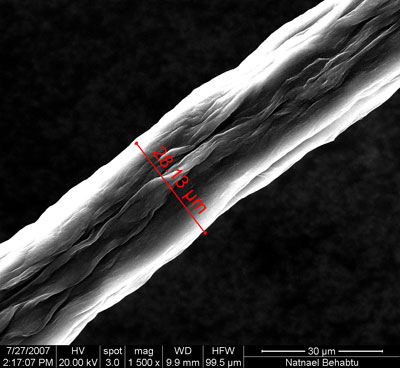
| Fiber of single-walled carbon nanotubes spun from acid. (Image: Dr. Matteo Pasquali, Rice University) | |
| The team has reported their findings in the November 1, 2009 online issue of Nature Nanotechnology ("True solutions of single-walled carbon nanotubes for assembly into macroscopic materials"). | |
| "The major advance compared to our earlier work (published in Science in 2004: "Macroscopic, Neat, Single-Walled Carbon Nanotube Fibers") is that back then we had a marginal solvent (sulfuric acid) rather than a good solvent (chlorosulfonic acid)," explains Pasquali. "We also understand clearly the science that controls this practical process. Understanding the science is very important because it helps us direct our future efforts." | |
| The scientists point out that they we now understand quantitatively the phase diagram of single-walled CNTs (SWCNTs) in strong acids. This phase diagram guides identification of the optimal starting fluid composition, and also provides insight into the solvent removal process (coagulation). | |
| "Coagulation plays a key role in determining micro- and macrostructure of fibres and films" says Pasquali. "The behavior in chlorosulphonic acid dispels the deep-seated notion that SWCNTs are essentially insoluble in any solvent." | |
| There are two notable advantages of this new method: Since the nanotubes are not chemically modified, their electronic properties are retained during the process; and despite being hazardous, acids are rather benign solvents for industrial use. | |
| In essence, Pasquali's team has established that the microstructure of the liquid-crystalline phase as well as ensuing macroscopic fibers and films is directly linked to solvent quality. Stronger acids yield larger liquid-crystalline domains and more uniform fibers and films. | |
| "These combined results place SWCNT processing onto a solid scientific ground and are likely to encourage further the engineering of macroscopic carbon nanotube materials," says Pasquali. "They will also have an impact on the numerous ongoing efforts for the combined bottom-up/top-down assembly of other cylindrical nanomaterials." | |
 By
Michael
Berger
– Michael is author of three books by the Royal Society of Chemistry:
Nano-Society: Pushing the Boundaries of Technology,
Nanotechnology: The Future is Tiny, and
Nanoengineering: The Skills and Tools Making Technology Invisible
Copyright ©
Nanowerk LLC
By
Michael
Berger
– Michael is author of three books by the Royal Society of Chemistry:
Nano-Society: Pushing the Boundaries of Technology,
Nanotechnology: The Future is Tiny, and
Nanoengineering: The Skills and Tools Making Technology Invisible
Copyright ©
Nanowerk LLC
|
|
|
Become a Spotlight guest author! Join our large and growing group of guest contributors. Have you just published a scientific paper or have other exciting developments to share with the nanotechnology community? Here is how to publish on nanowerk.com. |
|
