
| Posted: Jun 27, 2008 | |
'Cut and color' nanotechnology |
|
| (Nanowerk Spotlight) In recent years, great progress has been made in the synthesis and application studies of hybrid nanomaterial systems involving carbon nanotubes (CNTs). Efforts involve the alteration of physical properties of CNTs via the use of organic, inorganic, and biological species to produce functionalized CNTs for further applications. In one such hybrid system, aligned CNT templates serve as a natural 3D scaffold ('CNT forests'). Preferential assembly of nanoparticles onto targeted locations in this 3D scaffold creates novel hybrid nanomaterial systems with a unique architecture comprised of different functional components. For example, these CNT forests could serve as a template for controlled assembly of various semiconducting nanoparticles such as quantum dots. The resulting hybrid nanomaterial has the effect of changing both optical and electronic properties of the CNTs. | |
| "Quantum dots possess size tunable optical and electronic properties resulting from quantum confinement," Dr. Chorng-Haur Sow explains to Nanowerk. "Such properties allow them to be suitable candidates for applications in solar cells and light emitting devices. Having a high resistance to photobleaching, quantum dots are attractive materials for optoelectronics and in vivo biosensing. The technique of assembling quantum dots onto CNTs has drawn great attention." | |
| Sow, an Associate Professor in the Department of Physics at National University of Singapore (NUS), together with collaborators from the university's Department of Chemistry and the NUS Nanoscience and Nanotechnology Initiative, has now presented techniques to create patterned arrays of multi-walled carbon nanotube (MWCNT) microstructures decorated with quantum dots. | |
| An aligned array of intertwined MWCNTs was used as supporting template for a drying droplet of solution comprising quantum dots. When the solution evaporated away, quantum dots were left behind on the CNT template. Coupled with the technique of focused laser pruning, which was used to create CNT 3D micro-sculptures, a wide variety of quantum dot/CNT microstructures was created. The team's findings have been published in the June 11, 2008 online edition of ACS Nano ("Multicolored Carbon Nanotubes: Decorating Patterned Carbon Nanotube Microstructures with Quantum Dots "). | |
| Sow notes that quantum dot/CNT heterostructures show great potential in electronic device applications and therefore it is highly desirable to achieve a simple and cost-effective technique to assemble quantum dots onto CNT microstructures on a large-scale basis. He also points out that it would be ideal to selectively assemble quantum dots according to their sizes onto CNTs during the self-assembly process, but "to the best of our knowledge, there has been no report on such a technique with high definition of quantum dots size-selective assembly. This could be attributed to the difficulty in sorting quantum dots differing in size by only a few nanometers." | |
| "In our recent work, we introduce a three-dimensional (3D) quantum dots and MWCNT hybrid system created with a simple yet efficient technique" Sow explains. "This involves depositing quantum dots in suspension onto laser patterned MWCNT microstructures. Using the laser pruning technique, not only did we overcome pattern distortion due to solvents containing quantum dots, we also demonstrated the creation of a multicolored/multi component hybrid functional material through careful control of the laser power." | |
| Surprisingly, the aligned array of MWCNTs was also found to be an effective nanosieve that could effectively sort out quantum dots with a size difference of ∼0.5 nm. | |
 |
|
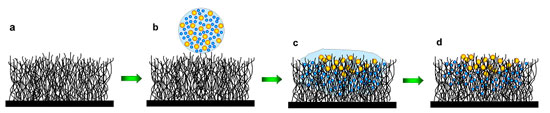
| Proposed working mechanism of the 3D NanoSieve. (a) Using as-grown MWCNTs as the sorting medium, (b) a droplet of quantum dots mixture was introduced to the MWCNTs sample. (c) As the solvent spreads out, particles get trapped depending on their size. (d) Finally, once the solvent has completely evaporated, quantum dots remained attached onto MWCNTs sample. (Image: Dr. Sow/NUS) | |
| A droplet of solution comprising quantum dots mixture of different sizes (e.g. 4 nm and 2 nm in core diameter) was placed on an aligned array of MWCNTs. As the solution spread across as well as trickled down the MWCNTs, larger quantum dots were readily trapped by the MWCNT network while the smaller quantum dots were found to venture further and deeper into the MWCNTs. Even if the smaller particles were trapped at the surface, their larger mobility allowed them to escape and spread out. Only when the solvent evaporates, would the smaller quantum dots be trapped. | |
| As a result, different quantum dots from the mixture became separated and assembled onto different part of the MWCNTs forest. This is akin to MWCNTs acting as a sieve to retain the larger particles while letting the smaller particles through. | |
 |
|
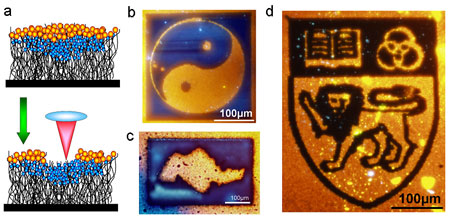
| (a) Schematic of laser trimming of the sample to reveal quantum dots assembled deeper into the CNT forest. Fluorescent microscopy images (top view) of the decorated pattern CNTs sample showing the multi-colored/multi-components hybrid functional materials. (b) Tai Chi Pattern, (c) Map of Singapore, (d) Logo for the National University of Singapore. (Image: Dr. Sow/NUS) | |
| "Again coupled with laser pruning, we could carefully trim away the top part of the decorated MWCNTs to reveal the smaller quantum dots deeper into the CNT forest," says Sow. "Fluorescence microscopy revealed multi-colored CNTs microstructures due to preferential decoration of these quantum dots with difference sizes. As a result, we achieved multi-colored/multi-component hybrid functional materials." | |
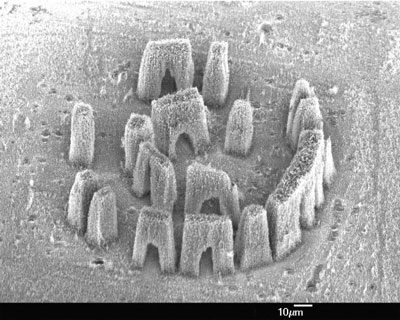
| Just as an aside: An example of the cool 3D microstructures that can be created using the laser pruning technique is the following 3D Micro Stonehenge Structure made of carbon nanotubes. Note that here in this case it is pure CNTs – no quantum dots involved. | |
 |
|
| 'Micro Stonehenge' (Image: Dr. Sow/NUS) | |
 By
Michael
Berger
– Michael is author of three books by the Royal Society of Chemistry:
Nano-Society: Pushing the Boundaries of Technology,
Nanotechnology: The Future is Tiny, and
Nanoengineering: The Skills and Tools Making Technology Invisible
Copyright ©
Nanowerk LLC
By
Michael
Berger
– Michael is author of three books by the Royal Society of Chemistry:
Nano-Society: Pushing the Boundaries of Technology,
Nanotechnology: The Future is Tiny, and
Nanoengineering: The Skills and Tools Making Technology Invisible
Copyright ©
Nanowerk LLC
|
Become a Spotlight guest author! Join our large and growing group of guest contributors. Have you just published a scientific paper or have other exciting developments to share with the nanotechnology community? Here is how to publish on nanowerk.com.