| Posted: Feb 17, 2009 | |
World's smallest nanotechnology motors are made from carbon nanotubes |
|
| (Nanowerk Spotlight) Just a few days ago we covered the exciting and quickly developing world of nanotechnology machinery, specifically nanomotors. In this previous Nanowerk Spotlight we focused on one approach to nanomotors, which is copying nature's catalytic biomotors. Today we will look at an example of mechanical approach that works with carbon nanotubes (CNTs). | |
| Some experimental work concerning CNT motor system has already been reported, but new work coming out of Japan could very well be the smallest motor so far. | |
| "We investigated the linear and rotary motions of a CNT capsule at room temperature when it is sealed by other CNTs in a hollow space of a host CNT" Kaori Hirahara tells Nanowerk. "It is the first observation of linear motion of CNT capsules. Such a system can be obtained by simply heating C60 peapods, and its size is comparable or much smaller than well-known protein-based molecular motors in the bioengineering field." | |
| The CNT motors reported by Hirahara, a member of the Frontier Research Base for Global Young Researchers and the Yoshikazu Nakayama lab at the Graduate School of Engineering at Osaka University, who collaborated with scientists from the Department of Mechanical Engineering, and the Department of Physics and Electronics at Osaka Prefecture University, have three important aspects: | |
| 1) They are the world's smallest synthesized motors. | |
| 2) Present work suggests that the driving force is simply thermal energy. | |
| 3) They can operate with seconds-order frequencies at around room temperature. | |
| The Japanese team worked with capsule-like, short multiwalled CNTs of only a few nanometers in diameter. In a paper in Nano Letters (A Molecular Linear Motor Consisting of Carbon Nanotubes), they present experimental evidence that such a CNT capsule works as a molecular linear motor as well as a molecular rotary motor inside the hollow spaces of host CNTs. | |
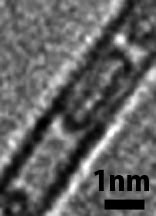
| Using a a transmission electron microscope (TEM), the scientists observed a CNT capsule – ∼0.95 nm in diameter and ∼3.2 nm in length – encapsulated in an interior hollow space of a single-walled CNT. | |
 |
|
| A TEM image of the CNT capsule. (Image: Dr. Hirahara, Osaka University) | |
| "After several seconds of observation, we found the capsule quickly travels to one side and, after a couple of seconds, travels back to the other side" says Hirahara. "In an observation of about 170 seconds, the capsule travels back and forth seven times." | |
| He points out that the 'linear-motor'-like motion of the CNT capsule observed in this study has two characteristics. "One is the second- scale time interval. We see the CNT capsule usually takes rest at either end for 1-5 seconds, and sometimes up to 40-50 seconds. The other is the very quick movement of the CNT capsule. It was difficult to capture the moment of movement in our experiment, so the traveling time from one end to the other is less than the frame rate (0.5 seconds)." | |
| The obvious questions that the team faced were 1) why the CNT capsule remains stationary at the ends and 2) what the driving force to start traveling is. As an answer to these questions, Hirahara and his colleagues propose that the CNT capsule becomes stationary at the ends owing to interactions with the caps based on the van der Waals interactions and that its travel is initiated by thermal energy. | |
| "One of the most intriguing results for the linear motor system in our study is the system operates around room temperature," says Hirahara. "The thermal energy obtained during ∼1s at room temperature is the appropriate amount to extricate the CNT capsule from the energy valleys at the ends of the hollow space; that is, there is thermal equilibrium. Control of the equilibrium between these two energies is essential in realizing effective control of the linear motion." | |
| For instance, if one would choose CNT capsules such that they are activated at a temperature slightly higher than the atmosphere temperature, their movement could be switched on and off by providing or stopping additional energies such as those of heat, light, and electron beams. | |
| The Japanese scientists believe that the CNT motors are applicable to frequency-tunable motors to generate the electromagnetic waves, switching devices and memory devices, etc. | |
| They are now working on the controllability of the motors. This includes a detailed examination of the motors' driving mechanism, i. e. the correlation between the motions – which is not only linear but also rotary – and the atomic structures such as chiralities as well as defects of individual CNTs. | |
 By
Michael
Berger
– Michael is author of three books by the Royal Society of Chemistry:
Nano-Society: Pushing the Boundaries of Technology,
Nanotechnology: The Future is Tiny, and
Nanoengineering: The Skills and Tools Making Technology Invisible
Copyright ©
Nanowerk LLC
By
Michael
Berger
– Michael is author of three books by the Royal Society of Chemistry:
Nano-Society: Pushing the Boundaries of Technology,
Nanotechnology: The Future is Tiny, and
Nanoengineering: The Skills and Tools Making Technology Invisible
Copyright ©
Nanowerk LLC
|
|
|
Become a Spotlight guest author! Join our large and growing group of guest contributors. Have you just published a scientific paper or have other exciting developments to share with the nanotechnology community? Here is how to publish on nanowerk.com. |
|
