

Nanotechnology Spotlight – Latest Articles
 Subscribe to our Nanotechnology Spotlight feed
Showing Spotlights 1505 - 1512 of 3580 in category All (newest first):
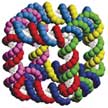
The ongoing development of DNA nanotechnology
DNA, the fundamental building block of our genetic makeup, has become an intense nanotechnology research field. Nanotechnology researchers use it to create artificial rationally designed nanostructures for diverse applications in biology, chemistry, and physics. In a progress report, scientists focus on the different design paradigms (DNA origami and the related techniques are particularly emphasized), selected high-quality shapes, and the software that enable user-friendly design and fabrication of DNA nanoobjects.
February 20, 2018
Creating highly tunable adhesives with Kirigami-inspired structures
Tuning adhesion without relying on chemical treatment or micro or nanostructured surfaces is now closer with a novel, kirigami-inspired approach. New research shows that by carefully designing arrays of cuts in an adhesive film, the stickiness can not only be tuned by a factor of 100 across a single sheet, but also be decreased for an easy-release purpose. These kirigami-inspired structures at interfaces provide a mechanism to spatially control and enhance adhesion strength while providing directional characteristics for high-capacity, easy-release interfaces.
February 19, 2018
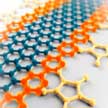
Fabricating 2D nanosheets from non-layered materials
Scientists report a systematic study involving theoretical and experimental approaches to evaluate the Li-ion storage capability in 2D atomic sheets of nonlayered MoO2. They describe a new process - polymer-assisted reduction - to make atomically flat 2D sheets of MoO2. Since MoO2 is not a 2D material, this process opens a new pathway to make 2D nanostructures from non-layered materials. By successfully making 2D atomic sheets of MoO2, the researchers fabricated a battery electrode in which the Li ion diffusion and electron transport are exceptionally fast.
February 15, 2018
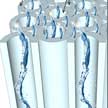
Wood nanotechnology for selective oil/water separation
Cellulose aerogels, made from nanofibrils found in plants, have several unique features, one of which is super high oil absorption capacity that is several times higher than commercial sorbents available in the market. Researchers have created wood-based structures for oil/water separation, utilizing the native feature of wood, i.e. its tubular porosity and hierarchical organization. The novelty here is the development of new processing routes for hierarchical wood structures scaled from nano-, micro-, to macroscales.
February 14, 2018
Perfect edges in graphene devices sabotage the Hall effect
Researchers have looked closer at the Hall effect in narrow graphene devices - so-called graphene nanoribbons and nanoconstrictions. They were puzzled when they found that the quantization of the conductance was destroyed in some samples - especially because these particular samples were optimized for low edge disorder and low contamination. As it turned out, this effect had been predicted by several theoretical physicists twenty years ago, but largely ignored since no experimental evidence was ever found.
February 13, 2018
Nanocoating wiggles surface clean
Researchers have developed a nanocoating that wipes off dust and sand from a surface by an electrical trigger, e.g. to clean solar panels in desert like conditions. This novel coating forms dynamic surface undulations fuelled by an alternating electric field. This new approach is based on resonance enhanced microscopic (di)electric coupling of polar mesogens to the electric field. Further applications could be removal of water droplets on car screens; dust removal from lenses and other optical systems; and controlling friction at or between surfaces.
February 12, 2018

Controlling the kinetics of ion-capturing/ion-releasing regimes in liquid crystals by means of nanoparticles
New work describes how to control the kinetics of ion-capturing/ion-releasing regimes in liquid crystals by means of nanoparticles. Various types of nanomaterials and alignment layers are considered major components of the next generation of advanced liquid crystal devices. While the steady-state properties of ion-capturing/ion-releasing processes in liquid crystals doped with nanoparticles and sandwiched between alignment films are relatively well understood, the kinetics of these phenomena remains practically unexplored.
February 9, 2018
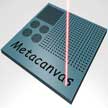
A rewritable metacanvas for photonic applications (w/video)
The metacanvas is a completely new generation of technology compared to all previous works. It is a tunable photonic devices based on vanadium dioxide that is lithography-free and fully reconfigurable. oth the patterns and the functionalities of the metacanvas can be arbitrarily reconfigured, which leads to many more degrees of freedom in metasurface design and functionalities. One piece of metacanvas is able to function as different optical components - hologram, phase-array, polarizer, modulator, etc. - at different times and on command, which has never been achieved in any of the previous VO2.
February 7, 2018