| Posted: May 13, 2009 | |
Nanotechnology helps building a highway for nerve fibers |
|
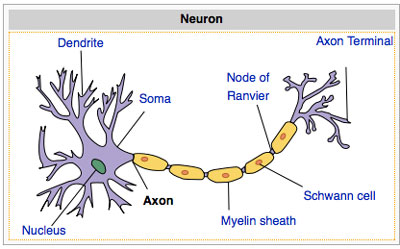
| (Nanowerk Spotlight) One of the key issues in building implantable neural interfaces is the guidance of axons, the individual nerve fibers that act as the primary transmission lines of the nervous system. | |
| "The ability to control the connections between neurons by guiding their axons on a chip surface offers several advantages," Christelle Prinz, a postdoc researcher in the Division of Solid State Physics at Lund University in Sweden, tells Nanowerk. "Among them is the possibility to address axons from different types of neurons, e.g., motor neurons from sensory neurons. This is a prerequisite condition for bidirectional neural implants such as brain machine interfaces." | |
 |
|
| Structure of a typical neuron (Image: Wikimedia) | |
| Axonal guidance has been achieved before, and there are various chemical and topographical modification techniques to do so. However, scientists only managed to control the orientation of the nerve fibers. In previous work for instance, Prinz and her collaborators have shown that they could guide axons along rows of nanowires with a high degree of fidelity (Axonal guidance on patterned free-standing nanowire surfaces). The problem was that the axons coming from two ganglia mounted on opposite side of the pattern would mix and they would grow in both directions. | |
| In new work that was recently published in Langmuir (Rectifying and Sorting of Regenerating Axons by Free-Standing Nanowire Patterns: A Highway for Nerve Fibers), the Swedish team shows that it is possible to impose a growth direction at a specific location on a substrate, something which is very important for neural chip construction for example. | |
| Prinz explains that they have used a rectifier pattern made of arrays of short rows of electron beam lithography (EBL)-defined nanowires to sort axons coming from different places on a substrate. The short rows of nanowires are oriented at an angle of 30° compared to the growth direction. The arrays define highways for axonal growth, preventing the axons to turn around and change their growth direction. | |
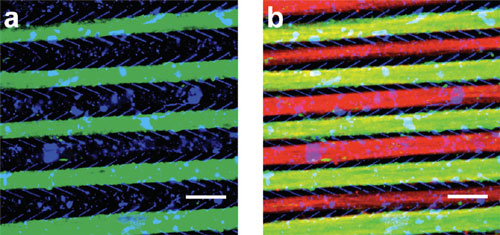
| "We not only show that patterns of nanowires can be used to rectify axonal outgrowth but we also demonstrate that axons from two different populations can be fully separated, thus creating the possibility to address two populations of axons on a chip surface," says Prinz. "These results, together with our earlier findings, provide a basis for the advanced control of neuronal growth on a chip, where a large range of functionalities can be implemented, including chemical sensors and electrodes to investigate neuronal function at high temporal and spatial resolution." | |
 |
|
| Confocal microscopy of bidirectionally rectified axonal outgrowth. (a) Nerve fibers from the green fluorescent protein (GFP)-expressing neurons from a ganglion mounted to the right. (b) The same image now showing the result of anti β-tubulin-labeled nerve fibers. The new (red) fibers originate from the wild-type ganglion mounted to the left. Because all fibers stain red, the GFP fibers now appear yellow. Scale bars 25 µm. (Reprinted with permission from American Chemical Society) | |
| The first application for this research would be in neural network design. By using the rectifying pattern, sensory neurons can be guided to one electrode for detection and motor neurons to another electrode for activation. | |
| Prinz points out two interesting findings from their research: "The first one is that the nanowire pattern influences axonal outgrowth well above the height of the nanowires. This is most likely due to axon-axon interactions and the tendency of axons to bundle, a phenomenon inherent to axons. The second one is that the guidance properties of the pattern are very powerful because one can observe both high and low nerve fiber densities on the same pattern without track crossing. It is also interesting how such very thin structures as nanowires can exert an influence on the much larger fiber bundles." | |
| Looking to future challenges for her team and researchers in this field, she notes that axonal guidance should take place in 3D, especially for prosthesis purposes. "Chemical modifications of surfaces are promising for designing 2D neural networks only" says Prinz. "Topographical modifications like nanowires or groves are a step towards guiding axons in 3D. Eventually, in order to be able to handle all the axons contained in a nerve in vivo, we have to start using 3D scaffolds." | |
| If you are interested in this topic of brain-machine interface, we have a number of Nanowerk Spotlights for you to read: | |
| Nanotechnology to repair the brain | |
| Nanotechnology coming to a brain near you | |
| Brain implants improved by nanotechnology coatings | |
 By
Michael
Berger
– Michael is author of three books by the Royal Society of Chemistry:
Nano-Society: Pushing the Boundaries of Technology,
Nanotechnology: The Future is Tiny, and
Nanoengineering: The Skills and Tools Making Technology Invisible
Copyright ©
Nanowerk LLC
By
Michael
Berger
– Michael is author of three books by the Royal Society of Chemistry:
Nano-Society: Pushing the Boundaries of Technology,
Nanotechnology: The Future is Tiny, and
Nanoengineering: The Skills and Tools Making Technology Invisible
Copyright ©
Nanowerk LLC
|
|
|
Become a Spotlight guest author! Join our large and growing group of guest contributors. Have you just published a scientific paper or have other exciting developments to share with the nanotechnology community? Here is how to publish on nanowerk.com. |
|
