| Posted: Aug 31, 2010 | |
Needle-free, painless vaccinations with nanopatches |
|
| (Nanowerk Spotlight) Australian researchers have introduced the Nanopatch – a new way of delivering vaccines to the skin and potentially a safer, cheaper alternative to traditional needle vaccines. The Nanopatch comprises arrays of densely packed projections with a defined geometry and distribution designed to physically target vaccines directly to thousands of epidermal and dermal antigen presenting cells. These miniaturized arrays are two orders of magnitude smaller than standard needles and are also much smaller than current microneedle arrays. | |
| The core idea is to achieve improved vaccine efficiency and effectiveness – over the needle and syringe – through precise targeting of vaccines to skin strata, achieved by device miniaturization utilizing micro- and nanotechnologies. | |
| "Most vaccines are administered intramuscularly with the needle and syringe" Mark Kendall, a professor at the University of Queensland and Group Leader, Delivery of Drugs and Genes Group (D2G2), Australian Institute for Bioengineering and Nanotechnology (AIBN), tells Nanowerk. "This method has several limitations, including needle phobia, accidental needle-stick injuries, plus improper and unsafe use contributing to the spread of infectious diseases." | |
| "Perhaps more importantly" says Kendall, "the needle does not necessarily place vaccine doses to the body sites known to elicit optimal immune responses. Instead, the needle and syringe primarily places antigen in muscle where immunologically sensitive cells are present at a much lower density, contrasting to thin viable skin layers, which contain a high density of antigen-presenting cells (APC) required for potent immune responses. Targeting of vaccines to these precise sites, using miniaturized devices could improve the efficacy of vaccines and other immunotherapies." | |
| Reporting their findings in a recent issue of Small ("Nanopatch-Targeted Skin Vaccination against West Nile Virus and Chikungunya Virus in Mice"), Kendall and his collaborators describe the Nanopatch approach for directly targeting vaccines to thousands of viable skin APCs. | |
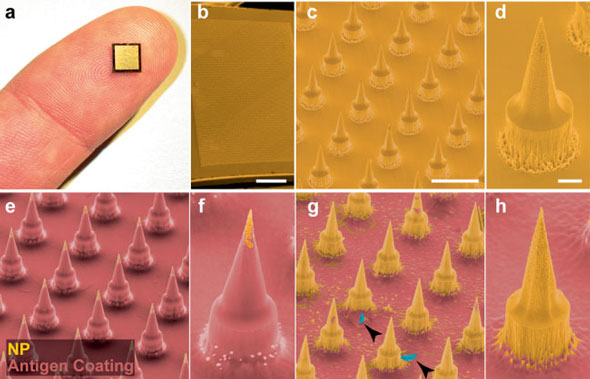
| The Nanopatch device is solid silicon, sputter-coated with a 100nm thin layer of gold, and measures 5mm x 5mm in size. The central 4mm x 4mm area contains 3364 densely packed individual projections that are 30µm at the base and between 65 and 110µm in length. Nanopatches are dry-coated with antigen, adjuvant, and/or DNA payloads. | |
 |
|
| Nanopatches (a-b, gold, bar is1 mm) contain 3364 individual projections (c-d, gold, bars indicate 50 and 10µm, respectively) that were 30µm at the base and between 65 and 110µm in length. These microprojections were coated with a novel nitrogen-jet drying method that resulted in a consistent and robust layer of antigen and/or adjuvant (e–f, red). The coated Nanopatch was applied to the skin at 2.0±0.1m/s for 10 minutes. After Nanopatch removal, the coating that was on the microprojections appears to have remained in the skin as expected (g, h). (Reprinted with permission from Wiley-VCH Verlag) | |
| The high density of the projections significantly increases the probability of targeting vaccine directly to the skin's immune cells in the viable epidermis and/or dermis within a given surface area of skin. | |
| When the patch is placed against the skin, these projections push through the outer skin layer and deliver the biomolecules to the target cells. When dry, the vaccine formulation is stable and strong. When the Nanopatch is applied to the skin, the projections immediately become wet, with the vaccine dissolving within minutes. | |
| Being both painless and needle-free, the Nanopatch offers hope for those with needle phobia, as well as improving the vaccination experience for young children. | |
| "When compared to a needle and syringe, a Nanopatch is competitive on cost, and it is easy to imagine a pandemic – such as swine flu – in which the Nanopatch is rapidly sent out to people in the mail," says Kendall. | |
| In their paper, the Australian team also explores the utility of Nanopatch devices to two different classes of vaccines that theoretically would see improved immunogenicity through the targeting of antigens directly to thousands of skin APCS – a DNA vaccine and also a virus-based vaccine. | |
| "After the Nanopatch was pressed onto mouse skin, a protein payload co-localized with about half of the APCs in the skin under the patch" says Kendall. "We then go on to show that this targeted delivery results in improved vaccination against both chikungunya virus and West Nile virus vaccine." | |
| He notes that both of these vaccines – for protection against WestNile virus and chikungunya virus – are experimental, i.e., not commercially available for human use. These viruses are globally important mosquito-borne viral pathogens and have recently been responsible for large outbreaks of debilitating and potentially fatal human disease. | |
| "We believe the efficacy and efficiency of our results is due to the projection targeting the vaccine directly to skin APC," says Kendall. "This miniaturized, needle-free delivery immunization technology offers a number of advantages, including no risk of needle stick injury, delivery of lower vaccine doses thereby reducing vaccine-induced inflammatory responses, small size, and minimal training requirements for use." | |
| The team is currently in the process of designing a Nanopatch to match the spatial arrangements of APC in human skin. | |
| "We have now proven the Nanopatch in the animal model" says Kendall. "The next step is to translate successfully to clinical studies, using the Nanopatch to vaccinate people." | |
 By
Michael
Berger
– Michael is author of three books by the Royal Society of Chemistry:
Nano-Society: Pushing the Boundaries of Technology,
Nanotechnology: The Future is Tiny, and
Nanoengineering: The Skills and Tools Making Technology Invisible
Copyright ©
Nanowerk LLC
By
Michael
Berger
– Michael is author of three books by the Royal Society of Chemistry:
Nano-Society: Pushing the Boundaries of Technology,
Nanotechnology: The Future is Tiny, and
Nanoengineering: The Skills and Tools Making Technology Invisible
Copyright ©
Nanowerk LLC
|
|
|
Become a Spotlight guest author! Join our large and growing group of guest contributors. Have you just published a scientific paper or have other exciting developments to share with the nanotechnology community? Here is how to publish on nanowerk.com. |
|
