
| Posted: Aug 04, 2006 | |
Quantum dot nanodevices with carbon nanotubes |
|
| (Nanowerk Spotlight) Carbon nanotubes are attractive materials as the building block of quantum-dot based nanodevices. In particular, single-wall carbon nanotubes (SWCNTs) are interesting because they become metallic and semiconducting, depending on how they are rolled up from the graphene sheet, and they could be applied to various devices such as ultrasmall field-effect transistors, single-electron devices, quantum computing devices, and light-emitting devices. A research group at the Japanese Institute of Physical and Chemical Research (RIKEN) has made extensive experimental efforts to apply SWCNTs to single-electron devices and quantum computing devices (spin qubit) with a single quantum dot as a basic structure. | |
| A single electron transistor (SET) is a device in which a quantum dot (QD) is connected with source and drain contacts through small tunnel junctions. A QD is a small metallic island in which electrons are confined. Therefore, it is sometimes compared with a natural atom, where electrons are confined in the Coulomb potential in a much smaller scale. When the discrete levels and the shell structure are clearly formed, the quantum dot is called an artificial atom. In the SWCNT QD, electrons are confined in a length direction as well as a circumference direction. | |
| The researchers at RIKEN demonstrated the artificial-atom nature of the SWCNT QD, with observations of shell structures and the Zeeman splitting of the single particle states. | |
| The operation of the SET is determined by the two external voltages, the source-drain voltage and the gate voltage. Its operation is well characterized by the so-called Coulomb diamond and the Coulomb oscillations. The RIKEN team's data indicate that the ideal single electron transistor or the single quantum dot is realized in the SWCNT. | |
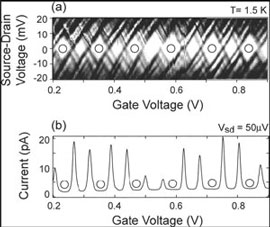 |
(top) Coulomb diamonds and (bottom) Coulomb oscillations of the SWCNT single quantum dot at 1.5°K. The two-electron periodicity is observed with a larger diamond and a larger peak-to-peak spacing in the Coulomb oscillations, as indicated by the circles. (Source: RIKEN Advanced Device Laboratory) |
| "In our experiments we have shown that a SWCNT QD behaves as an one-dimensional artificial atom with two or four electron shell structure" Dr. Koji Ishibashi, Chief Scientist and Head of the Advanced Device Laboratory at RIKEN, explained to Nanowerk. "We also observed the simple Zeeman splitting of single particle states, which is good for spin-based quantum bit, an elementary device for quantum computing devices." | |
| Examples of single-electron devices that Ishibashi's group fabricated are the single-electron inverter and the single-electron XOR gate. | |
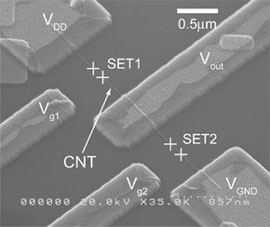 | 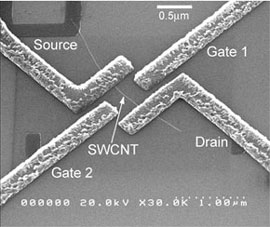 |
| (left) The CMOS-type single electron inverter is one of the simplest examples of the single electron logic devices. It consists of the two SETs connected in series. The CMOS-type single electron inverter makes use of the Coulomb peak of each SET as a complementary switch. The device fabricated with a multi-wall carbon nanotube is shown here. The group has also fabricated and demonstrated the device with SWCNTs. (right) The single electron XOR gate takes advantage of the periodic oscillation of the current as a function of the gate voltage. It has two identical input gates to the dot. The operation principle relies on the fact that the Coulomb peak as a function of one gate can be shifted by the other gate. (Source: RIKEN Advanced Device Laboratory) | |
| The performance of these two single-electron devices was demonstrated at liquid-helium temperature. Ishibashi expects the operation temperature to reach room temperature, judging from the single-electron charging energy, but it is limited to ∼10°K in their current devices because of the low tunnel-barrier height. | |
| Ishibashi points out that the SWCNT has advantages for single-electron devices especially in two points: first, they only need a small charging energy Ec; second, the possible isolated device structure may be immune to the background-charge problem that is always a concern for the SET fabricated in or on the substrate. | |
| SWCNT quantum-dot devices may open other device designs and may have interfaces to outside electronic circuits. | |
| "In our current work" concludes Ishibashi, "we show that carbon nanotubes are a promising building block for extremely small quantum-dot-based nanodevices that are not easily fabricated by standard microfabrication techniques. My view is that, although nanoelectronics is not exactly defined yet, it could take various forms with various functions which should be complementary to silicon electronics. For nanoelectronics, the CNT is one of the most attractive materials to realize it." | |
| Ishibashi's group's recent paper about their findings, titled "Quantum-dot nanodevices with carbon nanotubes" was published in the July 2006 edition of Journal of Vacuum Science & Technology A: Vacuum, Surfaces, and Films. | |
| Previous important papers on CNT QDs by Ishibashi's group include: "Four-Electron Shell Structures and an Interacting Two-Electron System in Carbon-Nanotube Quantum Dots", a May 2005 paper in Physical Review Letters, "Fabrication of a single-electron inverter in multiwall carbon nanotubes", a May 2003 paper in Applied Physics Letters and "Formation of coupled quantum dots in single-wall carbon nanotubes", a September 2001 paper in Applied Physics Letters. | |
 By
Michael
Berger
– Michael is author of three books by the Royal Society of Chemistry:
Nano-Society: Pushing the Boundaries of Technology,
Nanotechnology: The Future is Tiny, and
Nanoengineering: The Skills and Tools Making Technology Invisible
Copyright ©
Nanowerk LLC
By
Michael
Berger
– Michael is author of three books by the Royal Society of Chemistry:
Nano-Society: Pushing the Boundaries of Technology,
Nanotechnology: The Future is Tiny, and
Nanoengineering: The Skills and Tools Making Technology Invisible
Copyright ©
Nanowerk LLC
|
|
Become a Spotlight guest author! Join our large and growing group of guest contributors. Have you just published a scientific paper or have other exciting developments to share with the nanotechnology community? Here is how to publish on nanowerk.com.