

Nanotechnology News – Latest Headlines
New research advances with surface plasmon polariton waveguides
One of the key problems of nano-scale optical devices is how to guide and propagate incident light effectively. SPP waveguide has a long propagating distance and can transmit in metal-dielectric interface. How to enhance the coupling and transmission of SPP has attracted researchers' attention.
March 6, 2011 Read more
Nigeria universities to get nanomedicine center
National Universities Commission (NUC) has signed a Memorandum of Understanding (MOU) with the Institute for Lasers, Photonics, and Biophotonics (ILPB), United States of America for the development of an international joint research centre for nanomedicine in some Nigerian universities.
March 6, 2011 Read more
New instrument keeps an 'eye' on nanoparticles
Precision measurement in the world of nanoparticles has now become a possibility, thanks to scientists at UC Santa Barbara. The UCSB research team has developed a new instrument capable of detecting individual nanoparticles with diameters as small as a few tens of nanometers.
March 6, 2011 Read more
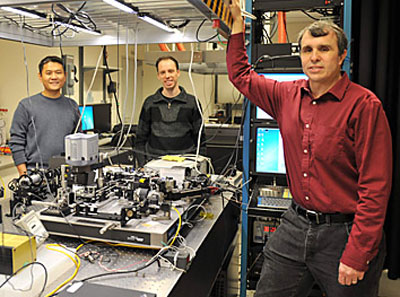
New microscope produces dazzling 3D movies of live cells
A new microscope invented by scientists at Howard Hughes Medical Institute's Janelia Farm Research Campus will let researchers use an exquisitely thin sheet of light -- similar to that used in supermarket bar-code scanners -- to peer inside single living cells, revealing the three-dimensional shapes of cellular landmarks in unprecedented detail. The microscopy technique images at high speed, so researchers can create dazzling movies that make biological processes, such as cell division, come alive.
March 4, 2011 Read more
ONAMI and SNNI announce Greener Nano 2011
The ONAMI Safer Nanomaterials and Nanomanufacturing Initiative's (SNNI) 6th annual Greener Nano Conference (GN11) - Advancing Applications and Reducing Risk - will be hosted by Hewlett-Packard Company at its Cupertino, CA site on May 1-3, 2011.
March 4, 2011 Read more
Friday fun - the elements song
The latest from the Periodic Table of Elements team
March 4, 2011 Read more
Zooming in on the weapons of Salmonella at subnanometer resolution
A research team was able to show details with dimensions of just 5 to 6 angstroems, which are nearly atomic orders of magnitude.
March 4, 2011 Read more
Join the Nanochannels teacher team!
European Schoolnet is launching a new call for teachers across Europe, to participate in the project NANOCHANNELS which just started in January 2011 and is funded under the 7th Framework Programme from Directorate-General Research.
March 4, 2011 Read more
New research on cement that self-repair cracks and store latent heat energy
Doctor Idurre Kaltzakorta introduced capsules filled with organic material into the cement, in a PhD thesis undertaken at Tecnalia and defended at the University of the Basque Country.
March 4, 2011 Read more
A breakthrough in the design of molecular motors
Researchers from CNRS and the Universite de Bordeaux, in collaboration with a Chinese team, have developed the first molecular piston capable of self-assembly. Their research represents a significant technological advance in the design of molecular motors. Such pistons could, for example, be used to manufacture artificial muscles or create polymers with controllable stiffness.
March 4, 2011 Read more
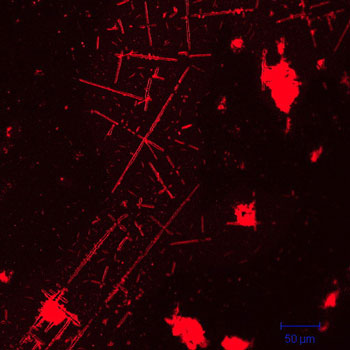
Quantenpunkte lassen Eiweissfasern leuchten
Materialwissenschaftler der Uni Jena erschaffen neues biophotonisches Hybridmaterial.
March 4, 2011 Read more
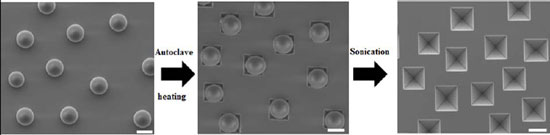
A misunderstanding leads to method for making nanowells
Similar patterned surfaces are currently made using complex and expensive photolithography methods and etch processes under clean room conditions and used in the fabrication of many optical, electrical, and mechanical devices.
March 4, 2011 Read more
New algorithm raises hopes that some of the barriers blocking the wider application of quantum computing could soon be solved
In recent years, quantum computers have lost some of their lustre. However, a new quantum algorithm, which shows how a quantum computer could be used to simulate a complex system of interacting particles, raises hopes that some of the barriers blocking the wider application of quantum computing could soon be solved.
March 4, 2011 Read more
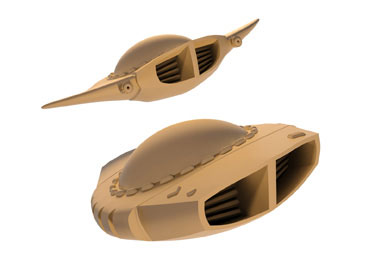
Mini-U-Boot gegen Krebs in der menschlichen Blutbahn
Ein visionaeres Entwicklungsprojekt der Hochschule Karlsruhe wird ab Maerz 2011 im Ars Electronica Center vorgestellt: Teil der neuen, gross angelegten Praesentation ist auch das Projekt "Nautilos". Das Mini-U-Boot "Nautilos" soll zur Krebstherapie in der menschlichen Blutbahn eingesetzt werden und mit optischen Methoden nahezu permanent das Blut seines Traegers untersuchen.
March 4, 2011 Read more
Researchers create single-atom lithography in graphene
The Rice lab of chemist James Tour reported this week in the journal Science that sputtering zinc onto multilayered graphene enabled the team to remove a single layer at a time without disturbing the layers beneath.
March 4, 2011 Read more
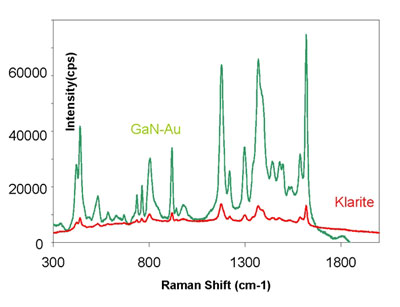
Revolutionary SERS nanosubstrates for medical tests
Gold-coated substrates of gallium nitride with specifically formed surface, developed by researchers from the Institute of Physical Chemistry of the Polish Academy of Sciences and the Institute of High Pressure Physics of the PAS display worldwide unique properties. Thanks to these new substrates, an extremely sensitive SERS analytical technique, capable of detecting even single molecules, after decades of waiting in specialized laboratories has finally got a chance to widespread and revolutionize medical diagnostics.
March 4, 2011 Read more
 Subscribe to our Nanotechnology News feed