

Nanotechnology Spotlight – Latest Articles
 Subscribe to our Nanotechnology Spotlight feed
Showing Spotlights 1657 - 1664 of 3580 in category All (newest first):

Preventing frost formation with nanoengineered surfaces (w/video)
Frost and ice accumulation result in significant decreases in the performance of ships, wind turbines, and heat exchangers. The use of active chemical, thermal, and mechanical methods of ice removal is time consuming and costly in operation. The development of passive methods to inhibit condensation, frost and ice formation is an attractive alternative. Examples are anoengineered anti-frost and anti-icing superhydrophobic and lubricant impregnated surfaces.
January 13, 2017
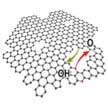
Topological defects make metal-free nanocarbon promising for zinc-air batteries
The oxygen reduction reaction (ORR) is the core process - but also the bottleneck - for the cathode reaction of energy-conversion devices like certain types of fuel cells and metal-air batteries. Nanocarbon materials are very promising alternatives for the noble metal catalysts, especially platinum, that have been used to boost this reaction. New work comprehensively reviews and correlates activity origins of nanocarbon-based ORR electrocatalysts, considering the dopants, edges, and defects. Specific doping at defective edges is expected to render practical applications for metal-free nanocarbon electrocatalysts.
January 12, 2017

Disposable biosensors made from newspaper
Paper, probably the cheapest and most widely used flexible and eco-friendly material in daily life, is a promising substrate for making flexible devices ranging from electronics to microfluidics, energy storage and sensors. In new work, researchers have developed a new and reliable method to achieve conformal coating of individual cellulose fibers in the paper and the fabrication of a metal electrode via patterning of gold and silver layers on the coated paper.
January 10, 2017

Controlling the structure and phase composition of lanthanide-doped alumina for emerging applications
Lanthanide dopants play an important role in desirable phase transformations of aluminum oxide (alumina) in order to achieve optimized physical and chemical properties. For example, the presence of dopants strengthens the grain boundaries of alumina, largely affecting its mechanical properties. New research indicates that there are significant structural changes to the lattice with addition of the dopant, and that understanding these effects will lead to future research for addressing these challenges.
January 9, 2017
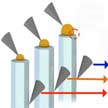
Combining catalytic and electrical contact edge-effects to engineer the transport properties of nanocontacts to nanowires
Electrical contacts are essential components for any electrical device and when a lack of control over the final properties is present designing and optimising the system is impossible. The ability to define the contacts as Schottky or Ohmic with high or low resistance is complicated by the 2-D, 1-D or quasi 1-D nature of many nanomaterials. That's why researchers have developed a deep understanding of a unique effect at these length scales that occurs in nanowires and combines the synergistic relationship between metal nanocatalyst particles and nanowires.
January 5, 2017

Our top 10 nanotechnology spotlight articles 2016
Here are the 10 most popular Nanowerk Nanotechnology Spotlight articles of 2016. This year, the list includes nanotechnology in textiles; nanotechnology for next-generation inkjet color printing; graphene-based smart contact lens works as self-powered biosensor; nanotechnology's tiny steps toward atomic-scale 3D fabrication; stick-on epidermal electronics tattoo to measure UV exposure; a nanotechnology approach to scavenging wind and solar energy in cities; 3D printing highly conductive nanocomposites; using household items to make a multi-sensory 'Paper Skin'; an analogue smart skin that is self-powered; and writing nanotubes with a nano fountain pen.
December 30, 2016

Consistent-chirality carbon nanotube tangles with high on-current in transistors
Great effort has been applied on the controllable synthesis of ideal carbon nanotubes (CNTs). However, it's almost impossible to directly synthesize pure semiconducting CNTs by an in situ catalytic reaction alone, without any post-separation, when only small amounts of metallic CNTs may cause catastrophic device shorting failures. That is why the synthesis of CNTs with consistent chirality and high density is facing a bottleneck. A group of researchers in China have creatively proposed a novel method by entangling an individual decimeter-long CNT with a diameter of 2 nm into a large tangle with high density and consistent chirality.
December 28, 2016
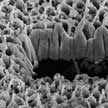
Black gold maximizes the light absorption of nanomaterials
Maximizing light absorption of nanomaterials has been an emerging research field in the recent years due to its attractiveness in a wide range of applications that involves conversion or utilization of solar energy. However, most of the concepts reported are based on multi-layered architecture inspired by optical impedance matching concepts that requires complicated non-scalable fabrication process such as electron beam lithography. Efforts on maximizing light absorption via nanostructuring remain scarce. Researchers have now reported such a material - a nanolayer of black gold.
December 21, 2016