

Solid-State Batteries: From Solid Electrolytes to Next-Generation Energy Storage
What Is a Solid-State Battery?
A solid-state battery is an electrochemical energy storage device in which the liquid or gel electrolyte of conventional lithium-ion cells is replaced by a solid ion-conducting material. The solid electrolyte serves simultaneously as the ionic transport medium and as a physical separator preventing electronic contact between the electrodes. By eliminating the flammable organic solvents used in traditional cells, solid-state designs inherently reduce the risk of thermal runaway – the self-accelerating heating process that can cause battery fires. This safety advantage, combined with the potential to use high-capacity lithium metal anodes, has made solid-state batteries one of the most actively pursued technologies in energy storage research.
The concept of solid-state ionic conduction dates to the early nineteenth century, when Michael Faraday observed that heated silver sulfide could conduct electricity through ion migration. Practical interest in solid-state batteries intensified after 2011, when Kamaya and colleagues reported that the sulfide compound Li10GeP2S12 (LGPS) achieved a lithium-ion conductivity of 12 mS cm–1 at room temperature – comparable to liquid electrolytes and an order of magnitude higher than any previously known solid conductor. That result demonstrated that the ionic conductivity barrier could be overcome and triggered a surge of global research into sulfide, oxide, halide, and polymer solid electrolytes.
Conventional lithium-ion batteries use graphite anodes with a theoretical specific capacity of 372 mAh g–1. A solid electrolyte that is stable against lithium metal opens the possibility of using a lithium metal anode with a theoretical capacity of 3,860 mAh g–1 – roughly a tenfold increase. Pairing such an anode with a high-voltage cathode could push cell-level energy densities beyond 500 Wh kg–1, compared with approximately 250–300 Wh kg–1 for the best current lithium-ion cells. Reaching those densities at scale is the central goal of solid-state battery development.
How Does a Solid-State Battery Work?
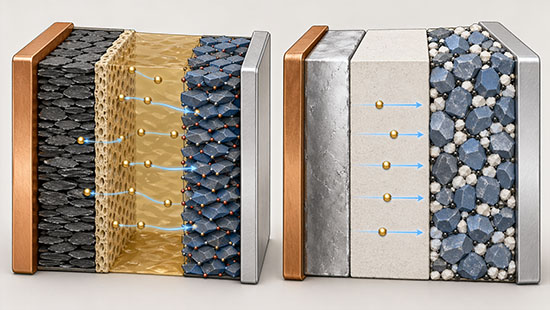
The operating principle of a solid-state battery is identical to that of any rechargeable lithium battery: lithium ions shuttle between two electrodes through an electrolyte during charge and discharge, while electrons flow through an external circuit to do useful work. What differs is the nature of the electrolyte. In a liquid-electrolyte cell, the electrolyte wets the electrode surfaces and fills every pore, ensuring continuous ionic contact. In a solid-state cell, ion transport must occur across rigid solid–solid interfaces, and maintaining intimate contact between the electrolyte and the electrode active material is far more difficult.
A typical solid-state cell consists of three layers: a cathode composite (active cathode material mixed with solid electrolyte powder and electronic conductive additives), a dense solid electrolyte separator, and an anode – either lithium metal foil, a silicon-based composite, or in anode-free designs, a bare current collector on which lithium plates during the first charge. The composite cathode must balance three interpenetrating transport networks: electrons through the conductive additive, lithium ions through the solid electrolyte phase, and lithium insertion into the active material particles. Optimizing this composite microstructure at the nanoscale is one of the defining engineering challenges of the technology.
Classes of Solid Electrolyte Materials
Solid electrolyte materials fall into four broad families, each with distinct advantages and trade-offs. The choice of electrolyte determines nearly every aspect of cell design: processing temperature, mechanical properties, chemical compatibility with electrodes, and achievable ionic conductivity. No single material currently satisfies all requirements, which is why composite and hybrid approaches are increasingly common.
Oxide Ceramics
Oxide-based solid electrolytes include garnet-type structures such as Li7La3Zr2O12 (LLZO), NASICON-type phosphates, and perovskite-structured lithium lanthanum titanates. Garnets are among the most studied because they combine moderate ionic conductivity (0.1–1 mS cm–1 at room temperature) with excellent electrochemical stability against lithium metal. Their principal drawbacks are brittleness, high grain boundary resistance in polycrystalline pellets, and the high sintering temperatures (above 1,000 °C) needed to densify them. Nanoceramic processing and thin-film deposition techniques such as atomic layer deposition (ALD) are being explored to reduce grain boundary impedance and lower processing costs.
Sulfide Glasses and Glass-Ceramics
Sulfide-based electrolytes – including Li10GeP2S12 (LGPS), argyrodite Li6PS5Cl, and Li3PS4 glass – hold the highest room-temperature ionic conductivities reported for any solid, reaching 10–25 mS cm–1 in optimized compositions. Their relatively soft, deformable character allows cold-pressing into dense pellets without high-temperature sintering, a significant manufacturing advantage. The major limitation is chemical instability: sulfides react with moisture to release toxic hydrogen sulfide gas, requiring moisture-free processing. They also have narrow electrochemical stability windows and tend to decompose at both cathode and anode interfaces, necessitating protective interfacial coatings.
Polymer Electrolytes
Polymer-based solid electrolytes, typically based on polyethylene oxide (PEO) complexed with a lithium salt such as lithium bis(trifluoromethanesulfonyl)imide (LiTFSI), are flexible, lightweight, and amenable to roll-to-roll manufacturing. Their main weakness is low ionic conductivity at room temperature (typically 10–5 to 10–4 S cm–1), which improves substantially above 60 °C as the polymer transitions from crystalline to amorphous. Composite polymer electrolytes incorporating ceramic nanoparticles or nanofibers can boost conductivity and mechanical strength, pushing practical operation closer to ambient conditions.
Halide Electrolytes
Halide-based solid electrolytes, such as Li3YCl6 and Li3InCl6, have emerged as a newer class with ionic conductivities in the range of 0.5–3 mS cm–1 and good oxidative stability against high-voltage cathodes. Unlike sulfides, halides are more tolerant of ambient air, though not indefinitely stable in humid conditions. Their compatibility with nickel-rich layered oxide cathodes makes them attractive for high-energy-density cells, and new lithium and sodium halide conductors are being reported at an accelerating pace.
The following table summarizes the key properties of these four electrolyte families.
| Electrolyte type | Ionic conductivity (mS cm–1, 25 °C) | Processing | Key advantages | Key limitations |
|---|---|---|---|---|
| Oxide (garnet, NASICON) | 0.1–1 | High-temperature sintering (>1,000 °C) | Stable against Li metal; wide electrochemical window | Brittle; high grain boundary resistance; expensive processing |
| Sulfide (LGPS, argyrodite) | 1–25 | Cold-pressing or mild heat treatment | Highest conductivity; mechanically soft; cold-pressable | Moisture-sensitive (H2S release); narrow stability window |
| Polymer (PEO-based) | 0.01–0.1 | Roll-to-roll film casting | Flexible; scalable manufacturing; lightweight | Low conductivity below 60 °C; limited oxidative stability |
| Halide (Li3YCl6-type) | 0.5–3 | Mechanochemical or mild thermal | Good cathode compatibility; moderate air stability | Unstable against Li metal; newer class with less maturity |
These trade-offs explain why no single electrolyte dominates: sulfides lead on conductivity but struggle with stability; oxides excel in stability but are difficult to process; polymers are the most manufacturable but the least conductive; and halides offer a promising middle ground still being optimized. Composite and bilayer electrolyte designs that combine two or more families are an increasingly common strategy.
The Interface Challenge
The most persistent obstacle to solid-state battery performance is not the bulk conductivity of the solid electrolyte but the resistance at the interfaces where the electrolyte meets the electrodes. In a liquid-electrolyte cell, the liquid conforms to every surface irregularity, ensuring continuous contact. At a solid–solid interface, microscopic voids, lattice mismatches, and chemical reaction layers can block ion transport. The resulting interfacial resistance often dominates total cell impedance and degrades during cycling as electrodes expand and contract with lithium insertion and removal.
At the cathode side, high-voltage oxide active materials such as LiCoO2 and nickel-rich layered oxides react with many solid electrolytes to form resistive interphase layers. Nanocoatings of lithium niobate (LiNbO3), lithium zirconate, or aluminum oxide applied to cathode particles by chemical vapor deposition (CVD) or ALD suppress these reactions by serving as chemically stable buffer layers only a few nanometers thick. At the anode side, the interface between lithium metal and the solid electrolyte must accommodate massive volume changes – lithium metal is stripped entirely during discharge and replated during charge – while maintaining continuous ionic contact. Strategies include applying external stack pressure, using three-dimensional current collectors made from nanowire or nanoporous metal frameworks, and engineering compliant interlayer materials that buffer the mechanical stress.
Nanoionics research has shown that interfacial ionic transport can differ substantially from bulk behavior. Space-charge layers, strain fields, and local compositional gradients at the nanoscale alter the concentration and mobility of lithium ions near interfaces. Computational approaches – density functional theory calculations and molecular dynamics simulations – have become essential for predicting interface stability and guiding material selection.
Dendrite Growth in Solid Electrolytes
One of the original motivations for solid-state batteries was the expectation that a rigid solid electrolyte would mechanically prevent dendrite growth – the branching metallic structures that cause short circuits in liquid-electrolyte lithium-metal cells. Early theoretical work by Monroe and Newman in 2005 predicted that a solid electrolyte with a shear modulus roughly twice that of lithium metal (approximately 4.2 GPa) should suppress dendritic protrusions. Many oxide ceramics exceed this threshold, yet lithium filaments have been observed penetrating polycrystalline LLZO, sulfide glasses, and polymer electrolytes under laboratory cycling conditions.
The penetration mechanism in ceramics differs from classical tip-growth dendrites in liquids. Lithium metal infiltrates pre-existing defects – grain boundaries, pores, microcracks, and regions where residual electronic conductivity provides a reduction pathway for lithium ions inside the electrolyte. Once a lithium filament enters a grain boundary, it can propagate rapidly under the combined driving forces of electrochemical potential and mechanical wedging. Amorphous solid electrolyte thin films without grain boundaries, such as lithium phosphorus oxynitride (LiPON), show substantially better resistance to lithium penetration.
Applications and Outlook
Electric vehicles are the most commercially significant target for solid-state batteries because higher energy density translates directly into longer driving range, while eliminating flammable liquid electrolytes simplifies thermal management. Several automotive manufacturers have announced development timelines for vehicles incorporating solid-state or semi-solid-state cells, with initial applications focusing on premium segments where higher cell costs can be absorbed. Thin-film solid-state microbatteries based on LiPON electrolytes have already been commercialized for medical implants, sensors, and Internet-of-Things devices, where their long cycle life and temperature tolerance offset limited energy capacity.
Grid-scale stationary storage is another potential application, particularly where safety and longevity are prioritized over upfront cost. Solid-state designs based on sodium or zinc chemistries – using earth-abundant elements – are being explored for large-format stationary cells. Nanoelectrochemistry and nanomaterials engineering continue to drive improvements across all solid-state chemistries, from designing interfacial nanocoatings that stabilize electrode contacts to synthesizing new nanocrystalline electrolyte phases with faster ion transport.
The principal remaining barriers are economic rather than purely scientific. Solid electrolyte materials cost more per kilogram than liquid electrolytes, and cell manufacturing processes have not yet achieved the throughput and yield of conventional lithium-ion production lines. Scaling sulfide electrolyte production while maintaining a dry manufacturing environment, densifying oxide ceramics without energy-intensive sintering, and establishing reliable quality control for solid–solid interfaces at production speed are challenges that sit at the intersection of materials science, chemical engineering, and manufacturing technology. Progress in nanofabrication and sol-gel synthesis is contributing to cost reduction by enabling lower processing temperatures and thinner electrolyte layers.
Frequently Asked Questions
How long do solid-state batteries last compared to lithium-ion batteries? Solid-state batteries have the potential to last significantly longer than conventional lithium-ion cells because the solid electrolyte does not decompose as readily as liquid electrolytes during cycling. Laboratory demonstrations of sulfide-based and oxide-based cells have exceeded 1,000 charge–discharge cycles with capacity retention above 80%. However, achieving this durability at high current densities and in large-format cells remains an engineering challenge, and real-world longevity data from commercial solid-state packs is still limited.
Can solid-state batteries catch fire? Solid-state batteries are inherently safer than liquid-electrolyte cells because they eliminate the flammable organic solvents that fuel thermal runaway in conventional lithium-ion batteries. An internal short circuit in a solid-state cell releases far less heat and produces no combustible vapor. That said, some sulfide-based solid electrolytes can generate toxic hydrogen sulfide gas when exposed to moisture, and lithium metal anodes remain highly reactive. The fire risk is greatly reduced but not entirely eliminated.
Why are solid-state batteries so expensive to manufacture? The high cost stems from several factors. Many solid electrolyte materials require energy-intensive high-temperature sintering or controlled-atmosphere processing. Achieving intimate solid–solid contact between electrodes and electrolyte demands precision manufacturing steps that have no counterpart in liquid-electrolyte cell assembly. Sulfide electrolytes must be handled in moisture-free environments, adding cost to factory infrastructure. Scaling these processes from laboratory coin cells to automotive-grade pouch or prismatic cells introduces yield challenges that conventional lithium-ion production lines solved decades ago.
What temperature range can solid-state batteries operate in? The operating temperature range depends on the electrolyte type. Oxide ceramics such as garnet-type LLZO function well from below 0 °C to above 100 °C but require elevated processing temperatures. Polymer electrolytes like PEO typically need operating temperatures above 60 °C to achieve adequate ionic conductivity, though composite designs have brought this threshold closer to room temperature. Sulfide-based electrolytes offer good room-temperature conductivity but degrade at high temperatures. Halide electrolytes show promising performance across a broad temperature window but are a newer class still under active development.
How fast can a solid-state battery be charged? Solid electrolytes can in principle support faster charging than liquid electrolytes because they allow only lithium-ion transport (transference number close to 1), which reduces concentration polarization at high current densities. Prototype solid-state cells have demonstrated charging from 10% to 80% in under 15 minutes under laboratory conditions. In practice, the achievable charging rate depends on the ionic conductivity of the electrolyte, the quality of the solid–solid interfaces, and the cell's thermal management. Sulfide-based electrolytes currently support the highest rates because of their superior conductivity, while oxide and polymer systems tend to require more moderate charging speeds.
Further Reading
Nature Materials, A lithium superionic conductor
Nature Reviews Materials, Understanding interface stability in solid-state batteries
Nature Energy, Challenges in speeding up solid-state battery development
