| Posted: Feb 19, 2009 | |
Nanosilver used in food storage materials found to interfere with DNA replication |
|
| (Nanowerk Spotlight) Silver has long been recognized for its infection-fighting properties and it has a long and intriguing history as an antibiotic in human health care. In ancient Greece and Rome, silver was used to fight infections and control spoilage. In the late 19th century, the botanist von Nägeli discovered that minute concentrations of silver contained microbiocidal properties. However, as the first antibiotics were discovered, this old household remedy was quickly forgotten. | |
| In its modern form, silver nanoparticles have become the promising antimicrobial material in a variety of applications because they can damage bacterial cells by destroying the enzymes that transport cell nutrient and weakening the cell membrane or cell wall and cytoplasm. For instance, an increasingly popular applications is to use pure silver, or silver-coated, nanoparticles in food packaging materials such as plastic bags, containers, films or pallet. | |
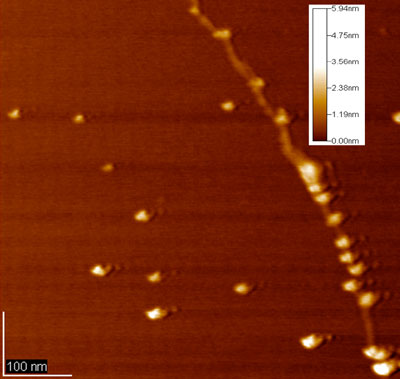
| A new study has found that silver nanoparticles can bind with double-stranded DNA and, possibly in this way, result in compromised DNA replication fidelity both in vitro and in vivo. But the study could not conclusively determine whether silver nanoparticles directly interact with DNA polymerases. | |
| There has been a heated discussion as to whether nanosilver should be regulated by agencies like the Food and Drug Administration, and while activist groups urge severe restrictions (see: Groups file legal action for EPA to stop sale of 200+ nanosilver products), the scientific picture of the risks of silver nanoparticles is not clear (see for instance Nanotechnology risks: the unclear fate of nanosilver). | |
| "Despite the wide application of nanosilver and many related studies on cytotoxicity to bacteria, there is still a serious lack of information concerning their long-term impact on human health and the environment," Zhizhou Zhang tells Nanowerk. "It has been suggested that DNA loses its replication ability once the bacteria are treated with silver ions and in our recent study we quantified the replication fidelity of the rpsL gene in E. coli when nanosilver particles were present in polymerase chain reactions (PCRs) or cell cultures." | |
| Reporting their findings in the February 2, 2009 online edition of Nanotechnology (Food storage material silver nanoparticles interfere with DNA replication fidelity and bind with DNA), Zhang, a professor at the Teda Bio-X Center for Systems Biotechnology at Tianjin University of Science and Technology, and his collaborators from Tianjin University and Shanghai Jiaotong University found that silver nanomaterials can directly interact with genomes. | |
 |
|
| Observed binding between silver nanoparticles and DNA molecule by AFM. (Reprinted with permission from IOP Publishing) | |
| Zhang says that, since the long-term influence of such interactions is unknown, scientists need to urgently explore this kind of interactions in detail and assess the relative safety of different nanoparticles systematically. | |
| By using a novel approach, the Chinese team showed provided new data in the context of silver-genome interactions that shows that silver nanoparticles induce compromised DNA replication fidelity. | |
| They started with the fidelity of DNA amplification/replication through a polymerase chain reaction (PCR) with a nanosilver aqueous suspension. | |
| "The PCR has been proven to be a very useful tool and a basic laboratory procedure for DNA replication in vitro" says Zhang. "The nucleotide mis-incorporation errors in PCR products can be determined by mutation assays. We used the rpsL forward mutation assay, which is a direct, time-resolved measurement for PCR fidelity. Besides, bacterial strains transformed with the wild-type rpsL gene can work as a model to detect the effects of nanomaterials on rpsL replication fidelity in vivo if the bacterial strains are incubated directly with nanomaterials." | |
| In their study, the effect of silver nanoparticles was explored for the first time on the DNA replication fidelity in vitro and in vivo, and the direct interaction between nanosilver and DNA was observed by atomic force microscopy (AFM). | |
| One important issue in this report is the toxicity assessment methodology of nanoparticles. Approaches for toxicity assessment of nanoparticles are not necessarily different from those used for general chemicals, though specific approaches for nanoparticles are expected to develop, leading to the emerging field on nanotoxicology (see: Toxicology - from coal mines to nanotechnology). | |
| "Several lines of investigations have been reported to measure the safety parameters of nanomaterials, and the approaches used in those studies will be all suitable for general chemicals" says Zhang. "In our study, perturbed DNA replication fidelity resulting from nanomaterials was employed for the potential long-term toxicity assessment. This is a novel convenient method to calculate the relative capacities of different nanoparticles to introduce DNA replication errors in the rpsL gene-based assays both in vitro (PCR) and in vivo." | |
| Another important issue in this report is the functional difference between silver nanoparticles and silver ions in the context of antibacterial activity and compromising the DNA replication fidelity. A large number of research reports have addressed this issue already. This new paper adds to the growing body of research that provides evidence that silver nanoparticles and silver ions inhibit bacterial growth and other cellular activities under different mechanisms. | |
| The rpsL-based assay used in Zhang's study has not been reported yet in the evaluation of the genotoxicity of chemicals, but it can be expected to play useful roles for long-term toxicity assessment for many nanomaterials. A particular challenge for future nanotoxicology research is to generate data of sufficient quality to determine if nanomaterials can influence genes, which in turn could lead to dramatically reshaped molecular network patterns in in cells. On the other hand, if it is found that specific nanoparticles exhibit affinities for specific genes, then this could be used in bionanotechnology to deliberately modify genomic DNA. | |
 By
Michael
Berger
– Michael is author of three books by the Royal Society of Chemistry:
Nano-Society: Pushing the Boundaries of Technology,
Nanotechnology: The Future is Tiny, and
Nanoengineering: The Skills and Tools Making Technology Invisible
Copyright ©
Nanowerk LLC
By
Michael
Berger
– Michael is author of three books by the Royal Society of Chemistry:
Nano-Society: Pushing the Boundaries of Technology,
Nanotechnology: The Future is Tiny, and
Nanoengineering: The Skills and Tools Making Technology Invisible
Copyright ©
Nanowerk LLC
|
|
|
Become a Spotlight guest author! Join our large and growing group of guest contributors. Have you just published a scientific paper or have other exciting developments to share with the nanotechnology community? Here is how to publish on nanowerk.com. |
|
