
| Posted: Apr 03, 2007 | |
Nanotechnology inspired by mussels and seashells |
|
| (Nanowerk Spotlight) Super-tough materials with exceptional mechanical properties are in critical need for applications under extreme conditions such as jet engines, power turbines, catalytic heat exchangers, military armors, aircrafts, and spacecrafts. Researchers involved in improving man-made composite materials are trying to understand how some of the amazing high-performance materials found in Nature can be copied or even improved upon. Nature has evolved complex bottom-up methods for fabricating ordered nanostructured materials that often have extraordinary mechanical strength and toughness. One of the best examples is nacre, the pearly internal layer of many mollusc shells. It has evolved through millions of years to a level of optimization currently achieved in very few engineered composites. In a novel approach, scientists have prepared a high-performing nanocomposite material that takes advantage of two different exceptional natural materials - layered nacre and the marine adhesive of mussels. The resulting nanostructured composite film exhibits high strength exceeding that of even nacre. | |
| The remarkable properties of some natural materials have motivated many researchers to synthesize biomimetic nanocomposites that attempt to reproduce Nature’s achievements and to understand the toughening and deformation mechanisms of natural nanocomposite materials. Preparation of artificial analogs of nacre has been approached by using several different methods and the resulting materials capture some of the characteristics of the natural composite. | |
 |
|
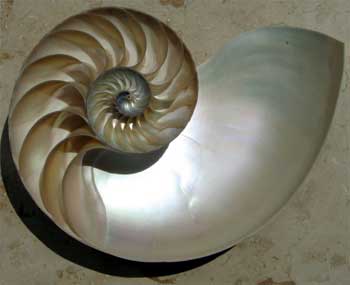
| The iridescent nacre of a Nautilus shell cut in half. (Image: Wiki Commons) | |
| "In our own work, we have used a layer-by- layer (LBL) assembly technique to prepare a nanostructured analogue of nacre from inorganic nanosized sheets of a particular clay and a polyelectrolyte (PDDA)" Nicholas Kotov tells Nanowerk. "The structure, deformation mechanism, and mechanical properties of this material were found to be comparable with those of natural nacre and lamellar bones." | |
| Kotov, an Associate Professor in Chemical Engineering at the University of Michigan, explains that, contrary to other preparation techniques, the LBL method is relatively simple and highly versatile in merging different functionalities into a single composite. "At the same time" he says, "a vast array of available assembly components allows us to generate alternative designs as a means of understanding the different interactions necessary for preparation of nacre-like composites with application-tailored mechanical responses." | |
| Trying to find ways of improving their composite material further, Kotov and his team turned to another exceptional biomaterial, the unusual protein adhesive secreted by mussels. | |
| "Clay nanosheets possess exceptionally high mechanical properties, with Y (Young's modulus) calculated at ca. 250–260 GPa, which is two orders of magnitude greater than the mechanical properties of most clay nanocomposites achieved thus far" says Kotov (in comparison, the Young's modulus for wrought iron and steel is 190-210 GPa). "We have hypothesized that improving load transfer from the weak polymeric component to the inorganic nanosheets in our artificial nacre should increase the composite’s mechanical properties. This required a polymer that would have a potentially stronger interaction with the clay than the ionic bonds in our clay/PDDA composite." | |
| Mussels secrete remarkable protein-based adhesive materials (mussel adhesive proteins – MAPs) for adherence to the substrates upon which they reside. The protein adhesives are secreted as fluids that undergo a hardening reaction leading to the formation of a solid adhesive plaque – think of cement – with which the mussel bonds to a variety of substrates such as minerals, metal surfaces, and wood. One of the unique structural features of MAP is the presence of DOPA, an amino acid that is believed to be responsible for both adhesive and crosslinking characteristics of MAPs. | |
| Kotov collaborated with the research group of Philip B. Messersmith at Northwestern University who are actively developing synthetic polymers that mimic the composition and properties of adhesive proteins found in nature such as DOPA. | |
| "The simultaneous strong binding, versatility and hardening capability of DOPA prompted us to exploit it for preparing artificial nanostructured nacre in the hope of enhancing the interfacial clay-polymer interaction and to increase mechanical properties of the composite" says Kotov. | |
| In a recent research paper in Advanced Materials, titled "Fusion of Seashell Nacre and Marine Bioadhesive Analogs: High-Strength Nanocomposite by Layer-by-Layer Assembly of Clay and L-3,4-Dihydroxyphenylalanine Polymer", Kotov, Messersmith and collaborators demonstrate, for the first time, preparation of a nanostructured composite having nacre-like architecture, which takes advantage of DOPA adhesion and crosslinking strength. | |
| "Just as in mussels, we found that DOPA molecules impart unusual adhesive strength to the clay composite and the hardening mechanism found in the natural 'cement' plays an equally important role in strengthening of our nanostructured nacre" says Kotov. " In comparison to our previous work with PDDA, we found that even a small amount of DOPA has a dramatic effect on the mechanical properties: the ultimate strength increased by two times and the toughness by approximately eight times." | |
| Overall, this work is a first example of the fusion of two seemingly distinct concepts found in Nature into a unique composite with excellent mechanical properties. It shows that understanding the nanoscale mechanics of materials could open the way for materials engineers to make new materials, based on nanocomposite structures, with exceptional strength. | |
| "However" cautions Kotov, "the greatest challenge is to transfer the unique mechanical properties of nanoscale components such as clay sheets used here for nacre replication into the properties of the actual macroscale materials." | |
 By
Michael
Berger
– Michael is author of three books by the Royal Society of Chemistry:
Nano-Society: Pushing the Boundaries of Technology,
Nanotechnology: The Future is Tiny, and
Nanoengineering: The Skills and Tools Making Technology Invisible
Copyright ©
Nanowerk LLC
By
Michael
Berger
– Michael is author of three books by the Royal Society of Chemistry:
Nano-Society: Pushing the Boundaries of Technology,
Nanotechnology: The Future is Tiny, and
Nanoengineering: The Skills and Tools Making Technology Invisible
Copyright ©
Nanowerk LLC
|
Become a Spotlight guest author! Join our large and growing group of guest contributors. Have you just published a scientific paper or have other exciting developments to share with the nanotechnology community? Here is how to publish on nanowerk.com.