
| Posted: Jul 08, 2008 | |
Nanotechnology pipettes as tools to demystify and modify biological processes |
|
| (Nanowerk Spotlight) Cells are the basic building blocks of life. The ability to sense and modify intracellular processes is important for, among other things, bettering our understanding of biological processes, developing drugs and evaluating their effectiveness, and modifying cell function. Due to the cell’s small size and fragility, probing the cell’s interior with high precision is not a simple task. To address this challenge, researchers have developed nanoscale, carbon-based cellular probes ('carbon nanopipettes' or CNP). | |
| In December last year, we wrote about research work at the University of Pennsylvania, where scientists have been developing nanosurgery tools to probe cells, monitor their processes, and control/alter their functions ("The modest pipette becomes a nanotechnology surgery tool"). Dr. Haim H. Bau's Micro-Nano Fluidics Laboratory already mass-produces carbon nanopipettes and can inject reagents into cells without damage. | |
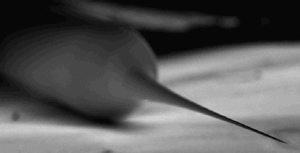
| The CNP consists of a glass capillary lined with a carbon film along its inner surface and terminating with an exposed carbon nanopipe. The probes are fabricated through a process that does not require any assembly and that facilitates quantity fabrication. Depending on controllable process conditions, the carbon tip’s diameter may vary from tens to hundreds of nanometers and its length can range from zero to a few micrometers (see: "The fabrication of integrated carbon pipes with sub-micron diameters"). | |
 |
|
| Integrated carbon-based nanopipette (Image: Dr. Bau/University of Pennsylvania) | |
| "The carbon pipes are flexible, can bend without breaking, and yet are sufficiently stiff to penetrate into cells," Bau explains. "Being hollow, the probes allow injection of reagents into the cell using standard cell physiology equipment. The probes are also conductive – through their carbon lining – allowing for electrical measurements. The CNPs can inject dyes and calcium secondary messengers into cells while maintaining cells’ viability. | |
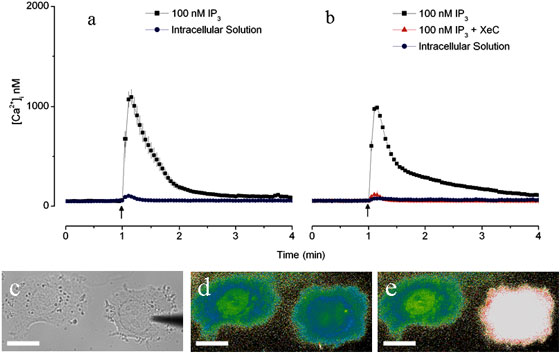
| In a recent paper, Bau and a group of collaborators that includes Dr. Yury Gogotsi from Drexel University, Dr. Sandip Patel from University College London, Dr. Nae Dun and Dr. Eugen Brailoiu from Temple University, together with first author Michael Schrlau, a PhD candidate in Bau's group, describe how they used the CNPs to inject calcium-mobilizing messengers into cells and identified several calcium-sensitive pathways in breast cancer cells. | |
| The scientists published a paper on their findings in the July 2, 2008 online issue of Nanotechnology ("Carbon nanopipettes characterize calcium release pathways in breast cancer cells"). | |
 |
|
| Calcium response to IP3. (a) Time-course of changes in intracellular calcium concentration upon injection of intracellular solution (blue circles) and IP3 (black squares) with CNPs. (b) Time-course of changes in intracellular calcium concentration upon injection of intracellular solution (blue circles) and IP3 either in the absence (black squares) or presence (red triangles) of XeC using conventional glass micropipettes. (c) Brightfield image of an IP3-filled CNP (dark feature above right cell) positioned tens of micrometers above a SKBR3 cell prior to injection. (d-e) Images of intracellular Fura-2 fluorescence ratios 2 sec before (d) and 1 sec after (e) injection of IP3 (only the right cell is injected). Scale bars: 10 µm. (Image: Reprinted with permission from IOP Publishing) | |
| The CNPs – which are compatible with standard laboratory equipment such as femtoinjectors and micromanipulators – were fabricated using a process described in a previous paper ("Carbon nanopipettes for cell probes and intracellular injection"). | |
| Although the tip diameters of these CNPs can be decreased to tens of nanometers, the scientists used relatively large pipettes (with tip outer diameters ranging from 200 to 400 nm) for this study in order to facilitate fluid transport and manipulation under light microscopy. | |
| "Our study demonstrated that, from the biological point of view, the CNPs have reproduced loyally results obtained with the commonly used glass pipettes" Bau tells Nanowerk. "The CNPs exhibited, however, many advantages over their glass counterparts such as smaller size (<400nm tip diameter), higher yield (fewer cells were destroyed when injected with CNPs compared to glass), better visibility under an optical microscope, and breakage and clogging resistance (on average, a glass pipette could be used to inject four cells before requiring replacement while the CNP could be used to inject dozens of cells without fail)." | |
| The more exciting applications of the CNPs are yet to come, says Bau. "CNPs are promising nanoscale, multifunctional probes that have the potential of assisting us in demystifying and modifying biological processes as well as serving as tools for injecting large numbers of cells for diagnostics, drug discovery, and therapeutics." | |
| Having established that the CNPs are nontoxic to cells – the researchers did not observe any adverse impact resulting from short duration penetration of carbon nanopipes into cells – the three groups from Penn, Drexel and Temple Universities, are now planning to | |
| 1) demonstrate probing individual organelles with CNPs with tip diameters in the tens of nanometers range; | |
| 2) functionalize the carbon tip’s surface with proteins, oligonucleotides, biomarkers, and nanoparticles to enable detection of target molecules with high spatial resolution and to modify the biological composition of the cell’s interior; and | |
| 3) take advantage of the high electrical conductivity of the CNPs to carry out electrical measurements for biosensing and for automated injection. The electrical measurements can be carried out concurrently with other probe functions such as injection. | |
 By
Michael
Berger
– Michael is author of three books by the Royal Society of Chemistry:
Nano-Society: Pushing the Boundaries of Technology,
Nanotechnology: The Future is Tiny, and
Nanoengineering: The Skills and Tools Making Technology Invisible
Copyright ©
Nanowerk LLC
By
Michael
Berger
– Michael is author of three books by the Royal Society of Chemistry:
Nano-Society: Pushing the Boundaries of Technology,
Nanotechnology: The Future is Tiny, and
Nanoengineering: The Skills and Tools Making Technology Invisible
Copyright ©
Nanowerk LLC
|
Become a Spotlight guest author! Join our large and growing group of guest contributors. Have you just published a scientific paper or have other exciting developments to share with the nanotechnology community? Here is how to publish on nanowerk.com.