
| Posted: Aug 15, 2008 | |
Peacock feathers and butterfly wings inspire bio-templated nanotechnology materials |
|
| (Nanowerk Spotlight) Photonic crystals – also known as photonic band gap material – are similar to semiconductors, only that the electrons are replaced by photons (i.e. light). By creating periodic structures out of materials with contrast in their dielectric constants, it becomes possible to guide the flow of light through the photonic crystals in a way similar to how electrons are directed through doped regions of semiconductors. The photonic band gap (that forbids propagation of a certain frequency range of light) gives rise to distinct optical phenomena and enables one to control light with amazing facility and produce effects that are impossible with conventional optics. | |
| A prominent example of a photonic crystal is the naturally occurring gemstone opal. Trying to create artificial opals, researchers have been experimenting with several varieties of synthetic photonic crystals (e.g. opals made up of polystyrene, silica, and PMMA) as structural matrices to incorporate light-emitting materials such as lasing dyes or quantum dots inside in order to achieve hybrid materials with tunable spontaneous emission. These structures are quite promising for performing directional and tunable emission, which is essential for diverse applications in optoelectronics and optical communications. | |
| The problem with artificial opals, which limits their applications, is that they lack in pattern variety and their fabrication requires very expensive equipment and sophisticated processes. In contrast, natural photonic crystals have various patterns that are quite promising structural matrices for creating novel optical devices. One example are peacock feathers, whose iridescent colors are derived from the 2D photonic crystals structure inside the cortex. | |
| "By varying the lattice constant and the number of periods in the photonic crystal structure, peacock feathers provide several 2D photonic crystal structures with different colors" Dr. Di Zhang tells Nanowerk. "In our recent nanotechnology research, we embedded light-emitting nanoparticles into natural photonic crystals in order to fabricate novel, biomaterial-based optical devices with tunable spontaneous emission." | |
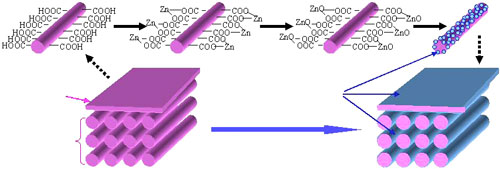
| Zhang, a professor at the State Key Laboratory of Metal Matrix Composites at Shanghai Jiao-Tong University in PR China, and his group have chosen peacock feathers as the matrix to embed zinc oxide (ZnO) nanoparticles through an in situ approach. | |
 |
|
| Illustration of the embedment of ZnO nanoparticles in a peacock feather. The peacock feather binds Zn2+ ions via carboxyl groups of aspartic and glutamic acid residues in keratin → in situ ZnO nucleation on the binding sites in a peacock feather → the formation of ZnO nanoparticles → nano-ZnO/peacock feather hybrids are obtained. (Reprinted with permission from IOP) | |
| Zhang explains that both the surface keratin layer and the keratin component connecting melanin rods in the feather cortex could provide reactive sites for the formation of ZnO nanoparticles. "In the resulting nanoZnO/peacock feather, the feather not only functions as the support for ZnO nanoparticles, but also should serve as the light controller according to its 2D photonic crystal structure, which is still under investigation." | |
| The scientists report their findings in the July 28, 2008 online edition of Nanotechnology ("Embedment of ZnO nanoparticles in the natural photonic crystals within peacock feathers"). | |
| "We assumed that, in an ideal system, the spontaneous emission is tuned both by the embedded nanostructures and by the photonic crystal matrix of the peacock feather, which is famous for its ability to control light in the visible range" says Zhang. "We chose ZnO nanoparticles as the light-emitting entity with defect emission that spans the visible spectrum. Meanwhile, the ordered melanin arrays within peacock feathers are chosen as the natural photonic crystals that have the ability of controlling visible light. In the resulting nanoZnO/peacock feather, the feather not only functions as the support for ZnO nanoparticles, but also should serve as the light controller according to its 2D photonic crystal structure." | |
| Zhang's group, as well as numerous research groups around the world, are inspired by the biomineralization processes found in nature – the process by which living organisms produce minerals. Whereas the fabrication of many man-made crystals requires elevated temperatures and strong chemical solutions, nature's organisms have long been able to lay down elaborate mineral structures at ambient temperatures. Being able to duplicate nature's 'production process' would potentially allow for much simpler and 'greener' fabrication technologies than the ones employed today. | |
| Zhang explains that various biomaterials, such as amino acids, dipeptides, DNA, microtubules and silk fibroins, have been investigated as ideal biomineralization substrates. "These biomatters mainly serve as the reactive chemical template, the surface modifier, as well as the bottom-up assembly director to control the formation and assembly of nanoparticles and nanoclusters in solution" he says. "However, further treatment, like spin-casting and Langmuir-Blodgett deposition technique, is needed to obtain solid state products for extensive applications. In our research, we introduce a facile route to in situ fabricate ZnO nanoparticles in solid state biosubstrate." | |
| Natural photonic crystals contain abundant reactive sites according to their chemical components, and thus, the Chinese scientists hypothesized, they could act as the reactive chemical template and surface modifier during the synthesis of ZnO nanoparticles. Furthermore, since the involved reactive bioresidues are dispersed in the solid state structures, this results in a nanoparticles/biomaterials hybrid nanocomposite without further treatment. | |
| This kind of nanocomposite material has potential applications in optoelectronics and optical communications. In addition, the in situ bio-inspired technique associated with constructing functional nanostructures on/in solid state biostructures could lead to various novel nanomaterials. | |
| In the past, the researchers in Zhang's group have already introduced a number of biomaterials and biostructures into their research in order to fabricate functional hybrid nanocomposites with hierarchical nanostructures. | |
| For instance, egg-shell membrane, wood and other plants organisms with hierarchical porous structures, have been used as template to synthesize hierarchical porous functional nanomaterials. | |
| "The specific hierarchical porous structures have been observed to influence the gas sensing and photocatalysis properties of biomorphic nanomaterials" says Zhang. "We also investigated silk fibroin fibers with strings-like morphology, bacteria with sphere and rod shapes, as well as butterfly wings, peacock feathers, and diatom frustules with ordered photonic crystal structures to integrate and enhance the functionalities of inorganic nanoparticles. The resulting hybrid nanocomposites exhibit outstanding chemical or physical properties and have valuable applications in photocatalysis, gas sensing, ductile ceramics, and semiconductor technology." | |
| Examples of some of the bio-inspired functional nanostructures achieved by Zhang's group have been reported previously: | |
| A facile and versatile method to fabricate the interwoven tubular hierarchy of tin oxide films using a biotemplate eggshell membrane combined sol–gel approach ("Fabrication and gas sensitivity of SnO2 hierarchical films with interwoven tubular conformation by a biotemplate-directed sol–gel technique"), eggshell membrane templated nanocomposite films that provide excellent photocatalysis ("Biogenic Synthesis and Photocatalysis of Pd-PdO Nanoclusters Reinforced Hierarchical TiO2 Films with Interwoven and Tubular Conformations"), porous microstructure templated from bacteria ("Novel Bacteria-Templated Sonochemical Route for the in situ One-Step Synthesis of ZnS Hollow Nanostructures"), a room-temperature, bio-inspired technique to synthesize hybrid nanocomposites consisting of well-dispersed CdS quantum dots and the substrate silk fibroin fibers ("In situ synthesis and photoluminescence of QD-CdS on silk fibroin fibers at room temperature"), or iridescent nanostructured ZnO replicas using butterfly wings as templates ("Biomimetic zinc oxide replica with structural color using butterfly (Ideopsis similis) wings as templates"). | |
| Bio-inspired fabrication techniques are multidisciplinary efforts that have developed into an intersection of materials science, soft chemistry techniques, nanotechnology, and biotechnology. Zhang points out that their methods and the relevant ideas provide a novel and versatile avenue to synthesize a new family of functional nanomaterials by integrating nanotechnology, material science, chemistry, and biotechnology. | |
| "We envisage that the exploration of these areas will provide new possibilities for the rational design of various kinds of functional nanomaterials with ideal hierarchy and controllable length scales," he says. "Bio-inspired strategies integrating biotemplate, biomineralization, and biomimesis will be extensively developed in the next few years to obtain functional nanocomposites with hierarchical architectures and interrelated unique properties." | |
 By
Michael
Berger
– Michael is author of three books by the Royal Society of Chemistry:
Nano-Society: Pushing the Boundaries of Technology,
Nanotechnology: The Future is Tiny, and
Nanoengineering: The Skills and Tools Making Technology Invisible
Copyright ©
Nanowerk LLC
By
Michael
Berger
– Michael is author of three books by the Royal Society of Chemistry:
Nano-Society: Pushing the Boundaries of Technology,
Nanotechnology: The Future is Tiny, and
Nanoengineering: The Skills and Tools Making Technology Invisible
Copyright ©
Nanowerk LLC
|
Become a Spotlight guest author! Join our large and growing group of guest contributors. Have you just published a scientific paper or have other exciting developments to share with the nanotechnology community? Here is how to publish on nanowerk.com.