
| Posted: Sep 19, 2008 | |
Nanotechnology, the mysterious Casimir Force, and interstellar spaceships |
|
| (Nanowerk Spotlight) Travel through wormholes, time machines and hovering landspeeders are the stuff of science fiction novels. Nevertheless, scientists have suggested that the quantum mechanics of something called the Casimir effect can be used to produce a locally mass-negative region of space-time, a phenomenon that theoretically could be used to stabilize a wormhole to allow faster than light travel ("Wormholes, Time Machines, and the Weak Energy Condition"). For many years the Casimir effect was little more than a theoretical curiosity. With the advances in micro- and nanotechnology and the fact that the Casimir force affects nanoscale devices such as NEMS, research in detecting and manipulating this mysterious force has generated substantial interest. | |
| Now, the secretive DARPA, a research agency of the U.S. Department of Defense that often dabbles in far-out technologies – and that also brought us the Internet's predecessor ARPANET – is soliciting innovative research proposals in the area of Casimir Effect Enhancement (Solicitation number DARPA-BAA-08-59. | |
| The goal of this program is to develop new methods to detect, control and dynamically manipulate (i.e. switch on and off) attractive and repulsive forces at surfaces based on engineering of the Casimir Force. One could leverage this ability to control phenomena such as adhesion in nanodevices, drag on vehicles and many other interactions of interest to the DoD. | |
| While even the folks at DARPA might find travel through wormholes a bit far-reaching, at least for now, the interest in the Casimir effect has some very practical implications for nanotechnology. As device dimensions reach the nanoscale, forces that are normally neglected in macroscale systems need to be taken into account. Since the Casimir force is the ultimate cause of friction in the nano-world, being able to manipulate the Casimir force in nanoscale devices could lead to zero-friction nanomachines with parts that actually levitate ("Quantum levitation by left-handed metamaterials"). It also would have a big impact on micro- and nanoscale production technologies since fabrication defects caused by stiction could be avoided, leading to yield improvements on batch-fabricated devices. | |
| Because of the still-speculative nature of much of the current work on manipulation of Casimir forces, a specific goal of this DARPA program is to determine if it is possible to manipulate and to neutralize the Casimir force in an experimental system. | |
| An excellent article from 2002 explains the nature of the Casimir effect, how to measure it, and its implications for nanotechnology (The Casimir effect: a force from nothing). It also describes how the phenomenon was discovered: | |
| "The fact that an attractive force exists between two conducting metal plates was first predicted in 1948 by Hendrik Casimir of Philips Research Laboratories in the Netherlands. At the time, however, Casimir was studying the properties of "colloidal solutions". These are viscous materials, such as paint and mayonnaise, that contain micron-sized particles in a liquid matrix. The properties of such solutions are determined by van der Waals forces – long-range, attractive forces that exist between neutral atoms and molecules. | |
| "One of Casimir's colleagues, Theo Overbeek, realized that the theory that was used at the time to explain van der Waals forces, which had been developed by Fritz London in 1932, did not properly explain the experimental measurements on colloids. Overbeek therefore asked Casimir to investigate the problem. Working with Dirk Polder, Casimir discovered that the interaction between two neutral molecules could be correctly described only if the fact that light travels at a finite speed was taken into account. | |
| "Soon afterwards, Casimir noticed that this result could be interpreted in terms of vacuum fluctuations. He then asked himself what would happen if there were two mirrors – rather than two molecules – facing each other in a vacuum. It was this work that led to his famous prediction of an attractive force between reflecting plates." | |
| The Casimir effect is rooted in one of those spooky sounding real world manifestations of quantum mechanics, namely that even an absolute vacuum is not empty, but bristling with virtual particles that constantly pop in and out of existence and, while here, buzz around for an undefined time. This phenomenon gives vacuum an energy, the so-called zero-point energy. | |
 |
|
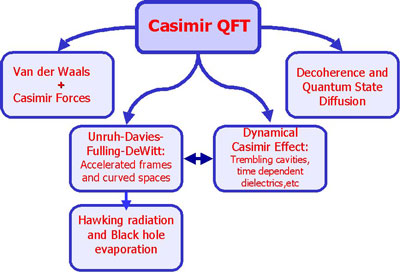
| The interrelationships of Casimir quantum field theory physics (Source: The Casimir Force) | |
| The DARPA request for proposal also provides an excellent explanation for why the Casimir effect is now becoming a major research interest: | |
| Recent advances in the ability to fabricate nanomechanical devices and to measure nanometer-scale forces have led to applications for van der Waals forces (non-contact atomic force microscopes uses the gradient in van der Waals force to detect proximity to the surface, for example). Van der Waals forces also play a role in attracting nanomechanical structures into contact, whereupon permanent adhesion can cause failure of the device. | |
| In practical devices, roughened surfaces, Teflon-like coatings, and mechanical design are used to overcome van der Waals adhesion. For example, the corners of the Texas Instrument Digital Micromirror Device (TI DMD) have tiny springs which store potential energy during the application of the electrostatic drive force; removal of the electrostatic force leads to the stored potential energy being released, which causes the mirror to be sprung free of the adhesive force. This is important in the DMD, as there are more than a million mirrors making contact to the surface at more than 10,000 times/second, and adhesion of any of the mirrors results in a detectable defect in the display. In other MEMS devices, such as inertial sensors, a Teflon-like film is deposited on the released micromechanical structures to reduce the surface energy of adhesion, and helping to prevent final adhesion and device failure. New ways to reduce or eliminate adhesive forces would allow improvements in MEMS reliability. | |
| As devices evolve from micro to nanoscale mechanical structures, the adhesive forces become relatively stronger. Researchers working to develop nanomechanical devices can mitigate adhesion by designing relatively stiff structures, but this leads to compromise in the range of motion or in the voltages required for actuation. The ability to reduce or eliminate adhesive forces would allow new designs and tradeoffs between all the other challenging issues in nanomechanical device design. | |
| The van der Waals force results from correlations in the fluctuations of the dipole moments of atoms on the opposite sides of the interface. The physics of the van der Waals force relies only upon the polarizability of the material and on the separation between the sides of the interface. The Hamaker constant, which captures the polarizability and other materials properties of importance, varies by only a single order of magnitude over practical materials. As a result, there is little opportunity to adjust or manipulate the van der Waals force and reduce the adhesion-induced failure of devices. | |
| The Casimir force arises from the interaction of the surfaces with the surrounding electromagnetic spectrum, and includes a complex dependence on the full dielectric function of both surfaces and the region between. The complexity of the Casimir force leads to significantly greater possibility for manipulation through materials, geometries, and other phenomena. The significantly greater complexity of the Casimir force potentially allows greater opportunity for neutralization or for use of Casimir forces to partially cancel van der Waals forces. | |
| There has been considerable recent effort to study the Casimir force, arising from the improvements in the ability to measure small forces near surfaces and improvements in the ability to complete complex numerical computations efficiently. Included in this activity has been growing speculation about the possibility to manipulate Casimir forces. This speculation has been primarily based on models and computations, but there are many very interesting applications for such an ability. | |
| As it now turns out, this is becoming a serious research area with DARPA being interested in funding approaches that can lead to the ability to manipulate Casimir forces. | |
| Ok, so what about those interstellar spaceships? In 1996, NASA actually started a program called Breakthrough Propulsion Physics – now practically dormant due to lack of funding – that looked at concepts like space drives and faster-than-light travel, the kind of breakthroughs that would make interstellar travel practical. | |
 |
|
| The basic idea is that if one could exploit the fact that vacuum is an energy reservoir, thanks to zero-point energy, future space travelers would have access to a limitless energy source. The only thing they need, of course, is some kind of propulsion system that harvests the required energy from the vacuum. That this is not totally crazy was demonstrated in a 1984 paper ("Extracting electrical energy from the vacuum by cohesion of charged foliated conductors"). Serious research efforts are being made in various laboratories to harness the Casimir and related effects for vacuum energy conversion. | |
| Some sci-fi minded types have speculated that this 'space drive' would have to be able to influence the interaction of the spaceship with the vacuum fluctuations in its direction of travel differently to the interaction with the vacuum fluctuations in its wake, perhaps by using attractive and repulsive configurations. The resulting imbalance might then be persuaded to cause propulsion. Don't expect that anytime soon, not even the guys at DARPA are looking at this yet. Or maybe they do: According to Harold E. Puthoff, Director of the Institute for Advanced Studies at Austin, "Under entry AF86-77, Air Force Rocket Propulsion Laboratory (AFRPL) Topic: Non-Conventional Propulsion Concepts we find the statement: 'Bold, new non-conventional propulsion concepts are solicited.... The specific areas in which AFRPL is interested include.... (6) Esoteric energy sources for propulsion including the zero point quantum dynamic energy of vacuum space.'". | |
 By
Michael
Berger
– Michael is author of three books by the Royal Society of Chemistry:
Nano-Society: Pushing the Boundaries of Technology,
Nanotechnology: The Future is Tiny, and
Nanoengineering: The Skills and Tools Making Technology Invisible
Copyright ©
Nanowerk LLC
By
Michael
Berger
– Michael is author of three books by the Royal Society of Chemistry:
Nano-Society: Pushing the Boundaries of Technology,
Nanotechnology: The Future is Tiny, and
Nanoengineering: The Skills and Tools Making Technology Invisible
Copyright ©
Nanowerk LLC
|
Become a Spotlight guest author! Join our large and growing group of guest contributors. Have you just published a scientific paper or have other exciting developments to share with the nanotechnology community? Here is how to publish on nanowerk.com.