
| Posted: Oct 07, 2008 | |
Novel, conceptual nanotechnology carbon material meets DOE's target for hydrogen storage |
|
| (Nanowerk Spotlight) Safe, efficient and compact hydrogen storage is a major challenge in order to realize hydrogen powered transport. According to the U.S. Department of Energy Freedom CAR program roadmap, the on-board hydrogen storage system should provide 6 weight % (6 %wt) of hydrogen capacity at room temperature to be considered for technological implementation. We have written several Nanowerk Spotlights where we introdduced and described novel, nanotechnology-based concepts for economically viable hydrogen storage methods (see: Nanotechnology storage tanks). | |
| Scientists consider the storage of hydrogen in the absorbed form as the most appropriate way to solve the storage problem and one particular group of materials they have focused on are carbon nanomaterials like nanotubes (read: New carbon nanotube hydrogen storage results surpass Freedom Car requirements) or fullerenes (read: Fullerenes for hydrogen storage). | |
| Research results so far have been uneven, though. On one hand, the U.S. Department of Energy (DOE) Hydrogen Program decided in 2006 to discontinue future applied research and development investment in pure, undoped single walled carbon nanotubes for vehicular hydrogen storage applications because nobody could demonstrate demonstrate that pure, undoped SWNTs could achieve the 6 %wt storage criterion. | |
| On the other hand, the DOE announced in August of this year that it had selected 10 hydrogen storage research and development projects to receive $15.3 million over the next 5 years. | |
| Offering a novel material approach, a theoretical investigation by researchers in Greece has shown that CNTs and graphene sheets could be combined to form novel 3-D nanostructures capable of enhancing hydrogen storage. | |
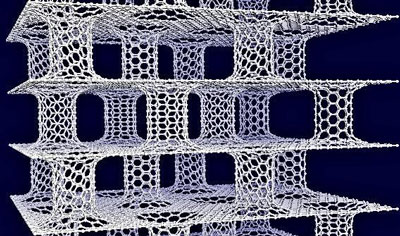
| "Carbon based materials are considered ideal candidates for hydrogen storage due to carbon's superior structural stability and amenability to a wide range of processing conditions" Dr. George E. Froudakis tells Nanowerk. "Keeping this in mind, we designed a novel 3-D carbon material with the unique property of tunable pores size. Pillared Graphene, as we termed it, consists of graphene sheets and carbon nanotubes – two different allotropies of carbon, which we combined to create a 3-D network nanostructure." | |
 |
|
| Pillared graphene. A novel 3-D network nanostructure proposed for enhanced hydrogen storage. (Image: Dr. Froudakis) | |
| Froudakis, an Associate Professor of Computational Chemistry at the University of Crete in Greece, together with his group, has demonstrated that when this new carbon material is doped with lithium atoms, Pillared Graphene is capable of reaching 6.1 wt% and 41 grams of hydrogen per liter – as gravimetric and volumetric capacities respectively – under ambient conditions, thereby fulfilling DOE's targets. | |
| The Greek researcher describe their findings in the September 19, 2008 online edition of Nano Letters ("Pillared Graphene: A New 3-D Network Nanostructure for Enhanced Hydrogen Storage"). | |
| One of the primary targets of Froudakis' group is to design, propose and investigate materials suitable for hydrogen storage under ambient conditions. Although Pillared Graphene so far is only a theoretical concept, if synthesized it could find use in automobile application, since it would be light and compact, and in any application that requires tunable pores, since its pores can be tuned at will. The catch of course is that this conceptual material first would need to be fabricated. | |
| The novel three-dimensional (3-D) carbon nanomaterial proposed by Froudakis and his colleagues consists of parallel graphene layers at a variable distance, stabilized by CNTs placed vertically to the graphene planes. In this way, CNTs support the graphene layers like pillars and assemble a 3-D building block reducing the empty space between the graphene layers by filling it with CNTs. | |
| "This is the real challenge for experimentalists – but feasible in our opinion" says Froudakis. "Lately, many similar carbon based structures have been fabricated and characterized, like fullerene intercalated graphites ("Synthesis of C60 intercalated graphite") and carbon nanobuds ("Novel carbon nanomaterial combines benefits of fullerenes and nanotubes"). These show the potential that structures like Pillared Graphene may not be just a product of our imagination, but a realistic possibility." | |
| Experimentalists – you've got your work cut out for you! | |
 By
Michael
Berger
– Michael is author of three books by the Royal Society of Chemistry:
Nano-Society: Pushing the Boundaries of Technology,
Nanotechnology: The Future is Tiny, and
Nanoengineering: The Skills and Tools Making Technology Invisible
Copyright ©
Nanowerk LLC
By
Michael
Berger
– Michael is author of three books by the Royal Society of Chemistry:
Nano-Society: Pushing the Boundaries of Technology,
Nanotechnology: The Future is Tiny, and
Nanoengineering: The Skills and Tools Making Technology Invisible
Copyright ©
Nanowerk LLC
|
Become a Spotlight guest author! Join our large and growing group of guest contributors. Have you just published a scientific paper or have other exciting developments to share with the nanotechnology community? Here is how to publish on nanowerk.com.