| Posted: Jan 13, 2009 | |
Nanoengineered vaccine capsules for the stimulation of immune responses |
|
| (Nanowerk Spotlight) Conventional vaccine development is based on the body's successful approach to dealing with viral infections: "Such infections typically induce immune responses involving both neutralizing antibodies that prevent further viral replication and cytotoxic T lymphocytes that recognize and eliminate infected cells that produce progeny virus. Such responses ultimately control and eliminate the virus effectively. Immunologic memory is established, and the person is left with protective immunity against subsequent infection with the same virus; this immunity is usually complete and long lasting" (source). | |
| Unfortunately, standard vaccine technologies are ineffective against some of the most devastating infectious diseases such as HIV. A key role in developing cell-mediated immunity against viruses is played by so-called T-cells, which belong to a group of white blood cells known as lymphocytes. One variant of T-cells (cytotoxic T lymphocytes) directly attacks body cells that are infected with a virus or malignant or abnormal tumor cells. These 'killer' T-cells are called into action by 'helper' T-cells, which also activate other immune cells to produce antibodies. HIV, though, takes over helper T-cells and uses them to replicate itself. A major focus in AIDS research has therefore been the development of a 'T-cell vaccine' that induces T-cell immunity. | |
| While it was shown that peptides in blood could effectively stimulate T cell immunity in monkeys, and peptides are considered safe vaccine antigens, proteases in vivo can rapidly degrade peptide-based vaccines and this has limited their utility to date. New research by scientists in Australia represents an important finding for vaccine delivery as it demonstrates a feasible method for protecting biologically active peptides for delivery to antigen presenting cells (APCs). | |
| "Unlike other particulate systems, our layer by layer (LbL) nanoengineered capsules allow us to have fine control over the properties of the capsules and as such we are able to tailor the capsules to facilitate vaccine delivery," Frank Caruso tells Nanowerk. "We surveyed nanoengineered capsules with a number of different surface chemistries and demonstrated that LbL capsules are efficiently internalized by APCs, such as dendritic cells, in human blood. Furthermore, peptide contained within the capsules was intracellularly released, trafficked and presented by the APCs to result in immune stimulation in vitro." | |
 |
|
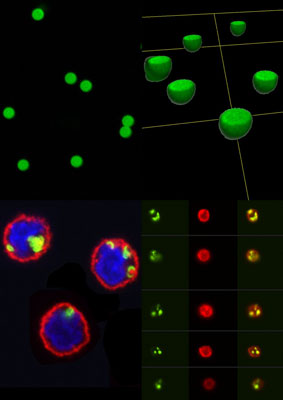
| Confocal and Imaging Flow cytometry of nanoengineered capsules and their interactions with blood cells: (clockwise from top-left) Confocal cross-section of peptide (green) encapsulated inside capsules; 3D confocal reconstruction of peptide encapsulated inside capsules; Imaging flow cytometry showing the internalisation of the capsules (green) inside dendritic cells (red); Confocal cross-section of capsules internalised into dendritic cells (capsules - green, nucleus - blue, cell membrane - red). (Image: Dr. Caruso, University of Melbourne). | |
| Caruso is Director of the University of Melbourne's Centre for Nanoscience and Nanotechnology and leads the Nanostructured Interfaces & Materials Group (NIMS) in the Department of Chemical and Biomolecular Engineering. Previously we have reported about his group's pioneering work on nanostructured colloidal materials ("Nanostructured colloidal systems inspired by nature"). | |
| In this recent work, Caruso collaborated with the group of Stephen J. Kent, at the university's Department of Microbiology and Immunology. The team's results, reported in Advanced Materials ("Binding, Internalization, and Antigen Presentation of Vaccine-Loaded Nanoengineered Capsules in Blood"), represent an important finding for vaccine delivery as it demonstrates a feasible method for protecting biologically active peptides for delivery to APCs. | |
| By encapsulating a model HIV vaccine peptide (KP9) within biodeconstructible capsules, the researchers show that KP9 is internalized into the APCs and intracellularly trafficked to responding primate lymphocytes to elicit an immune response. | |
| The team is now investigating other ways to tailor their capsules for vaccine delivery, such as functionalizing the surface of the capsules to specifically target APCs and incorporating adjuvant molecules into the structure of the capsule to enhance immune responses. | |
| Caruso says that he and his collaborators expect these nanoengineered, vaccine-loaded capsules to be highly efficient for the stimulation of immune responses to a wide range of diseases and will not be limited to the delivery of peptide antigens. | |
| "Our future plans are to extend these promising results to in vivo studies and investigate the immunostimulaory capability and protective efficacy of peptide loaded capsules using disease models in both mice and macaques," he says. "We believe that this exciting and novel delivery technology represents a significant advance in vaccine research which could have an impact on many important diseases." | |
 By
Michael
Berger
– Michael is author of three books by the Royal Society of Chemistry:
Nano-Society: Pushing the Boundaries of Technology,
Nanotechnology: The Future is Tiny, and
Nanoengineering: The Skills and Tools Making Technology Invisible
Copyright ©
Nanowerk LLC
By
Michael
Berger
– Michael is author of three books by the Royal Society of Chemistry:
Nano-Society: Pushing the Boundaries of Technology,
Nanotechnology: The Future is Tiny, and
Nanoengineering: The Skills and Tools Making Technology Invisible
Copyright ©
Nanowerk LLC
|
|
|
Become a Spotlight guest author! Join our large and growing group of guest contributors. Have you just published a scientific paper or have other exciting developments to share with the nanotechnology community? Here is how to publish on nanowerk.com. |
|
