| Posted: Jan 21, 2009 | |
Nanotechnology tools could lead to new uses for collagen |
|
| (Nanowerk Spotlight) Collagen is one of the most essential and plentiful proteins in humans, making up about one quarter of all proteins in the body. It is also a major component of connective tissue such as cartilage, ligaments, tendons, bone and skin. Due to its excellent biocompatibility, biodegradability, and the ease of extraction, purification, and processing, collagen has found use as a versatile biomaterial in numerous medical applications. | |
| However, collagen is susceptible to biodegradation and the mechanical stability of native collagen for use in tissue repair is insufficient. In order to slow down the biodegradation rate, researchers have developed numerous chemical cross-linking techniques where individual protein chains are linked with a covalent bond, thereby stabilizing the protein. | |
| Scientists have now proposed a novel approach to collagen cross-linking on the basis of gold nanoparticles, opening a path to using collagen as a medium for delivery of drug molecules. At the same time, because gold nanoparticles are used in imaging and cell targeting – gold nanoparticles can include other functionalities attached to their surface, for example biomolecules, targeting agents etc. – they can serve as a medium for delivery of nanoparticles. | |
| "There is a large variety of cross-linking agents where a linear molecule has two reactive sites (2-way) to bind to collagen," Kasha Slowinska explains to Nanowerk. "Since the geometry of the agents used thus far is similar, they generate gels with similar properties. In nature, natural cross-linking occurs as collagen ages. This causes the significant changes in the collagen containing tissues, for example skin elasticity decreases dramatically as a result of the aging process. The pyridinoline cross-link is thought to be responsible for structural and mechanical differences between young and aged collagen. This cross-link provides a 3-way connection – three side groups of collagen connected together. In our research we proposed to use a 'multiple-way' linker, gold nanoparticles, to create collagen gels with a unique structure." | |
 |
|
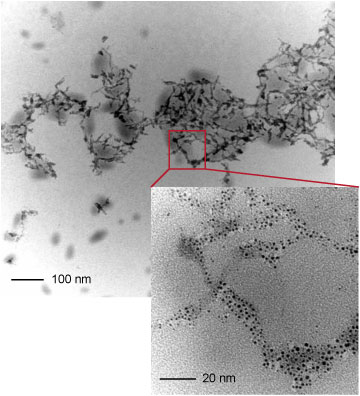
| TEM of collagen crosslinked with gold nanoparticles. (Image: Dr. Slowinska, California State University, Long Beach) | |
| Slowinska, an assistant professor of analytical chemistry, bioanalytical chemistry and bioengineering at the California State University, Long Beach, together with members of her group, has published their findings in Biomacromolecules ("Collagen Cross-Linking with Au Nanoparticles"). | |
| Since multiple carboxyl groups are present on the surface of gold nanoparticles, these are capable of forming multiple cross-links with the collagen. The formation of the peptide bonds between collagen molecules in this particular work has been achieved with a coupling agent commonly used in chemical cross-linking (EDC). | |
| "Our group has been working on improving properties of collagen gels prepared for targeted drug delivery" says Slowinska. "We are now proposing a new type of cross-linking agent – tiopronin modified gold nanoparticles – that form multiple cross-links with collagen molecules. As a result, we have obtained a novel class of collagen material in which the porosity of the collagen gel can be easily adjusted." | |
| Gold nanoparticles exhibit excellent biocompatibility, can be easily functionalized with biomolecules (growth factors, DNA, peptides, etc.), and are already frequently used as drug delivery systems. Applying gold nanoparticles as a cross-linking agent in collagen gels therefore allows for easy incorporation of these biomolecules by their immobilization on the surface of the gold nanoparticles, without additional altering of the collagen structure. | |
| The results demonstrated by Slowinska's group show that EDC-assisted cross-linking of collagen with tiopronin-protected gold nanoclusters results in the formation of about eight bonds between each nanoparticle and the collagen molecules. | |
| Slowinska points out that the control over porosity of collagen gels is of utmost importance in drug delivery applications and tissue engineering. "The use of gold nanoclusters as a cross-linking agent allowed us to control the pore size by simply changing the concentration of nanoclusters." | |
| The resulting gels show improved stability against biodegradation and are biocompatible. | |
| One of the goals of the group is to create organized structures with well defined porosity, small pore dispersion, and good biocompatibility. "We want to achieve this goal by using tools developed for nanotechnology applications" says Slowinska. "However, a significant challenge in this area is related to the unknown effects of long term exposure to bionanomaterials and we are devoting time to design new tools to assess the safety of these materials." | |
 By
Michael
Berger
– Michael is author of three books by the Royal Society of Chemistry:
Nano-Society: Pushing the Boundaries of Technology,
Nanotechnology: The Future is Tiny, and
Nanoengineering: The Skills and Tools Making Technology Invisible
Copyright ©
Nanowerk LLC
By
Michael
Berger
– Michael is author of three books by the Royal Society of Chemistry:
Nano-Society: Pushing the Boundaries of Technology,
Nanotechnology: The Future is Tiny, and
Nanoengineering: The Skills and Tools Making Technology Invisible
Copyright ©
Nanowerk LLC
|
|
|
Become a Spotlight guest author! Join our large and growing group of guest contributors. Have you just published a scientific paper or have other exciting developments to share with the nanotechnology community? Here is how to publish on nanowerk.com. |
|
