
| Posted: Dec 09, 2008 | |
Self-healing protection for plastic electronics |
|
| (Nanowerk Spotlight) Thin-film organic electronic devices are at the core of the fast growing plastic electronics industry that aims to deliver flexible, lightweight and cheap electronics products to consumers in many different shapes and forms such as disposable or wraparound displays, cheap identification tags, low cost solar cells and chemical and pressure sensitive sensors. | |
| The performance of devices like organic light emitting diodes (OLEDs), flexible solar cells, or plastic electronics is sensitive to moisture because water and oxygen molecules seep past the protective plastic layer over time and degrade the organic materials which form the core of these products. To protect these sensitive devices, barrier technologies have been developed that protect them from environmental degradation. State-of-the-art barrier materials employ metal oxide (MOx) thin films, commonly from aluminum or silicon oxides, which provide excellent protection from atmospheric oxygen and water, but still suffer from two problem areas: | |
| 1) Defects such as pinholes, cracks and grain boundaries are common in thin oxide barrier films when fabricated onto plastic substrates. These defects cause a ‘pore effect’, where oxygen and water molecules are able to seep through and penetrate the plastic barrier. 2) MOx films are brittle, which can result in cracks upon repeated flexing. | |
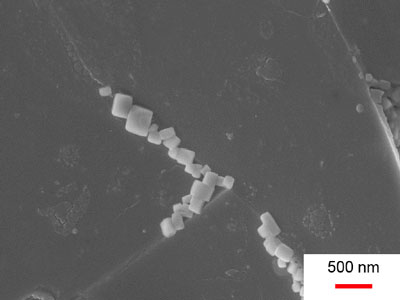
| A new study demonstrates a nanocomposite material that can initiate self-healing upon the influx of water through pores and cracks by delivering titanium dioxide nanoparticles to the defective site, which ultimately slows the rate of moisture diffusion to the reactive electronic device. | |
 |
|
| Right angle crack on metal oxide layer showing the growth of titanium dioxide along the fracture. (Image: Harvey Liu, University of Texas at Dallas) | |
| "The concept of self-healing has become a popular theme in the field of material science" Kenneth J. Balkus, Jr. tells Nanowerk. "While the idea of self-healing has been around for many years, recent studies on the autonomic healing of structural polymers has brought about a new wave of research." (We have reported on several recent activities in this area in previous Spotlights: Nanomaterial, heal thyself and Self-healing nanotechnology anticorrosion coatings as alternative to toxic chromium) | |
| Balkus, a professor of chemistry at the University of Texas at Dallas, points out that, while these studies present a novel method for the autonomic healing of polymer matrices, the application of this strategy to self-healing metal oxides is not possible since the fundamental property of metal oxide thin films in permeation barriers that makes them appealing is their ability to exclude water and oxygen, a feat that polymeric healing cannot achieve. | |
| "This challenge has led us to develop a method to encapsulate highly reactive materials in a polymer shell," says Harvey A. Liu, a student in Balkus's group and first author of a recent paper in Advanced Functional Materials that describes this work ("A Delivery System for Self-Healing Inorganic Films"). | |
| "Since the major source of device failure is the influx of moisture through stress-induced cracks, as well as through defects, we have developed a system that is not only physically responsive to flexing, but also chemically responsive to the influx of moisture," Liu describes the team's work. "In order to perform this action we have employed a water-degradable polymer, poly(lactic acid) (PLA), as the shell structure to encapsulate the healing agent, titanium tetrachloride. TiCl4 was chosen because of its rapid reactivity, volatility, and its ability to propagate repair without the introduction of a catalyst." | |
| Liu explains how their proposed delivery system for healing agents works: "The permeation barrier consists of a metal oxide and a polymer. Integrated within the polymer layer are porous fibers composed of a water-degradable polymer encapsulating a reactive metal oxide precursor. The influx of atmospheric moisture through holes in the inorganic layer caused by stress-induced cracks or defects leads to the hydrolysis of the degradable polymer. The degradation of the polymer releases the metal oxide precursor, which diffuses into the crack and subsequently reacts with moisture to form a solid metal oxide to seal the crack." | |
| Liu points out that their strategy does not solve the problem of cracking within the permeation barrier, but it does provide the potential for prolonging the effectiveness of the permeation barriers in excluding moisture, thus prolonging the lifetime of the organic electronic devices. | |
| Interestingly, the technique developed by Balkus's team not only addresses self-healing of thin metal oxide films but can also be considered a method to store and release a highly reactive material in a biodegradable biocompatible polymer; something that could find uses in other areas, for instance drug delivery. | |
| The team is currently exploring the use of new metal oxide precursors and attempts to extend this methodology to other types of films such as coatings for corrosion prevention. | |
 By
Michael
Berger
– Michael is author of three books by the Royal Society of Chemistry:
Nano-Society: Pushing the Boundaries of Technology,
Nanotechnology: The Future is Tiny, and
Nanoengineering: The Skills and Tools Making Technology Invisible
Copyright ©
Nanowerk LLC
By
Michael
Berger
– Michael is author of three books by the Royal Society of Chemistry:
Nano-Society: Pushing the Boundaries of Technology,
Nanotechnology: The Future is Tiny, and
Nanoengineering: The Skills and Tools Making Technology Invisible
Copyright ©
Nanowerk LLC
|
|
Become a Spotlight guest author! Join our large and growing group of guest contributors. Have you just published a scientific paper or have other exciting developments to share with the nanotechnology community? Here is how to publish on nanowerk.com.