| Posted: Jan 25, 2012 | |
NanoRiskCat - A conceptual decision support tool for nanomaterials |
|
| (Nanowerk Spotlight) In a project funded by the Danish Environemntal Protection Agency (EPA), the Technical University of Denmark (DTU) and National Research Centre for the Working Environment have initiated the development of a screening tool called NanoRiskCat (NRC) for the evaluation of exposure and hazard of nanomaterials contained in products for professional and private use. | |
| Authored by Steffen Foss Hansen and Anders Braun from DTU's Department of Environmental Engineering and Keld Alstrup-Jensen from the National Research Centre for the Working Environment Environmental Project, the 268-page report on the NanRiskCat screening tool can be downloaded as a PDF file from the Danish EPA's website. | |
| The project's aim was to identify, categorize and rank the possible exposure and hazards associated with a nanomaterial in a product. NanoRiskCat is using a stepwise approach based on existing data on the conventional form of the chemical as well as the data that may exist on the nanoform. However, the tool still needs to be further validated and tested on a series of various nano products in order to adjust and optimize the concept and thereby to achieve a screening tool as informative and practical as possible. | |
| It is the view of the Danish EPA that the traffic light ranking of the health effects may be further modified to obtain a better ranking in the various categories. Thus titanium dioxide in sunscreen is ranked as red due to lung effects of titanium dioxide, because the tool in its present form does not sufficiently take account of which type of health effects that are most relevant for the most relevant exposure route of the product. In this case the inhalational exposure of titanium dioxide from a sun screen seems less relevant. | |
| Executive Summary | |
| Nanomaterials are being used in a rapidly increasing number of products available for industries and private consumers. The number of nanomaterials that can be manufactured using nanotechnologies is immense and the improved material properties enable use in multiple different products. During the last decade more and more evidence has emerged in the scientific literature suggesting that some nanomaterials may have hazardous properties. | |
| With this background, the Danish Environmental Protection Agency has identified a need for developing a new concept that can provide support to companies and regulators in regard to assessing, ranking and communicating what they know about the risks of nanomaterials in specific product uses. In this case, risk should be defined as a combination of the likelihood of exposure and adverse effects, i.e. any chance of an adverse outcome to human health, the quality of life, or the quality of environment. | |
| Through this project, DTU Environment and the National Research Centre for the Working Environment have initiated the development of a screening tool, NanoRiskCat (NRC), that is able to identify, categorize and rank exposures and effects of nanomaterials used in consumer products based on data available in the peer-reviewed scientific literature and other regulatory relevant sources of information and data. The primary focus was on nanomaterials relevant for professional end-users and consumers as, as well as nanomaterials released into the environment. | |
| The wider goal of NanoRiskCat is to help manufacturers, down-stream endusers, regulators and other stakeholders to evaluate, rank and communicate the potential for exposure and effects through a tiered approach in which the specific applications of a given nanomaterial are evaluated. This is done by providing detailed guidance on mapping and reporting of the: | |
| 1. Exposure potential for professional end-users 2. Exposure potential for consumers 3. Exposure potential for the environment 4. A preliminary hazard evaluation for humans 5. A preliminary hazard evaluation for the environment | |
| A generic template for mapping and reporting these five aspects for a specific application of a given nanomaterial has been developed and can be found in Appendix 1 of the report. | |
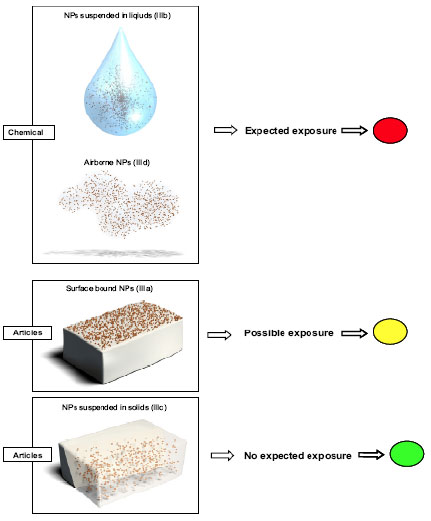
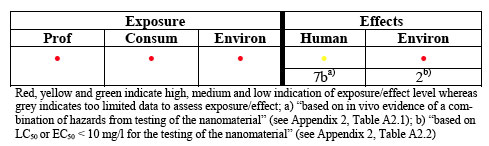
| In its simplest form, the final outcome of using NanoRiskCat for a nanomaterial in a given application will be communicated in the form of a short title describing the use of the nanomaterial (e.g. MeO in ship paint) and a five-color coded dots, where the first three dots always refer to potential exposure of professional end-users, consumers and the environment in that sequence and the last two colors always refer to the hazard potential for humans and the environment. The colors signify whether the indications of exposures or effects separately are high (red), medium (yellow), low (green), or unknown (grey). | |
 |
|
| Generic approach used in NanoRiskCat to assign the color-code to products with no, possible and expected exposure depending on the location of the nanomaterial in the product. | |
| The color-coding of the dots representing the exposure potential (dost numbers one to three) is based on the generic use descriptor system established by the European Chemicals Agency (ECHA) in the current REACH Guidance on information requirements and chemical safety assessment Appendix R.124. For each use category, a color code has been assigned based on 1) the location of the nanomaterial (bulk, on the surface, liquid or airborne) and 2) a judgment of the potential for nanomaterial exposure based on the description and explanation of each process, product category, technical function, article and environmental release category provided in the REACH Guidance. | |
| When assigning a color to the dot representing potential human health hazards (dot number four) related to the specific application of a given nanomaterial the following indicators/qualifiers should be considered: | |
| 1. Does the nanomaterial fulfil the HARN paradigm? | |
| 2. Is the bulk form of the nanomaterial known to cause or may cause serious damaging effects, i.e. is the bulk form classified according to the CLP with regard to one or more serious health hazards such as germ cell mutagenicity, carcinogenicity or reproductive toxicity in category 1A, 1B or 2? | |
| 3. Is the bulk form of the nanomaterial classified for other less severe adverse effects according to the CLP such as skin corrosion/irritation category 2 and specific target organ toxicity-single exposure category 3? | |
| 4. Is the specific nanomaterial known to be acute toxic? | |
| 5. Are there indications that the nanomaterial causes genotoxic, mutagenic, carcinogenic, respiratory, cardiovascular, neurotoxic or reproductive effects in humans and/or laboratory animals or has organ-specific accumulation been documented? | |
| The human hazards information on the bulk form of the material may be used as a starting point in order to describe a possible minimum level of concern in regard to the toxicological profile for the nanomaterial. A guiding principle is that information about the bulk form of the material can be used under the assumption that any toxicological and ecotoxicological effects of the nanomaterial are equal to or larger than those reported on for the bulk material. Thus hazard data on the bulk material forms the basis of the lowest level of concern with regard to the nanomaterial. | |
| In NRC, indications of the level of environmental effects (dot number five) should include considerations of whether the nanomaterial in question is reported to be: | |
| 1. Hazardous to environmental species? | |
| 2. Persistent? | |
| 3. Bioaccumulative? | |
| 4. Leading to potentially irreversible harm to the environment (e.g. ecosystem effects)? | |
| 5. Readily dispersed? | |
| 6. Novel? | |
| It is important to note that NanoRiskCat is a stepwise and tiered approach in the sense that once a color code has been triggered this finalizes the screening process. | |
| To help communicate the scientific reasoning behind the human health and environmental hazard categorization and the assigned color code, a number of standard sentences have been included in the framework. These sentences are primarily meant to reflect whether the categorization has been reached based on in vivo or in vitro studies and in regard to which effect or endpoint. Depending to the final categorization in regard to human health and environment, the user of NRC has to select one or more of those sentences that best reflect the scientific basis for assigning the color code. | |
| In order to illustrate the feasibility of NanoRiskCat two nanomaterials (titanium dioxide and C60) were used as training sets in two different applications i.e. C60 used in a lubricant and TiO2 used in sunscreen. These examples were chosen order to be used in the development of the concept but they are also included in the current report in order to illustrate the applicability of NanoRiskCat. | |
 |
|
| Example of the evaluation of environmental hazard of C60 in C60 LubExtreme according to NanoRiskCat. | |
| It is important to underline that NanoRiskCat is not a product label and NanoRiskCat is only to be used for evaluating the nanomaterial as an ingredient under the physical conditions it occurs in the product. NanoRiskCat does not evaluate exposure and effects from the other constituents and impurities in the product nor does it take into account the specific content of nanomaterial in the product. Thus, NanoRiskCat is directed towards the generic use descriptors and scenarios, which for instance are apparent in the product categories used in REACH. Although NanoRiskCat is generic in nature and can be used on all kinds of nanomaterials and applications, the NanoRiskCat color code itself is application-specific. Thus, a NanoRiskCat color code does not in itself allow for an overall evaluation of risks associated with a given nanomaterial. | |
| A significant strength of NanoRiskCat is that it can be used even in cases where lack of data is prominent and hampers the completion of traditional risk assessment procedures. Another is that the results of NanoRiskCat can be easily communicated to interested parties. A significant weakness of NanoRiskCat is that many of the cut-off values used primarily in the environmental hazard evaluation is based on dose-by-mass which we know is probably not valid for all nanomaterials as it is an ongoing discussion on which dose-metrics will be the best to use in nano-ecotoxicology. Furthermore, the process by which the color code is assigned to human hazards associated with the nanoform of a given material is based primarily on scientific expert judgement and a holistic assessment of the evidence of mutagenicity, carcinogenicity, respiratory toxicity, etc. As expert interpretation of scientific literature vary, so can the conclusion reached and the human hazard color code assigned to nanomaterial. It is not possible to provide clear-cut guidance and rules at this point in time for how to complete holistic evaluation of the human and environmental hazards associated with the nanoform of a given material. It is crucial in this context that the users of the NRC explain what literature they have identified as relevant and explain how they interpret the reported results and assign the various color codes in the NRC template provided in Appendix 1. | |
| The result of NRC does not lead directly to an decision in contrast to other decision-making tools available for nanomaterials, but NRC does provide a informed and structured foundation for decision-making by including a number of indicators that define whether exposure and effects are likely (or unlikely) to occur and whether the nanomaterial may have harmful properties of concern. | |
| Decisions that could come out of using NanoRiskCat are stakeholder-dependent. Regulators could use NRC as a screening tool to identify possible uses where risk management measures may be further examined e.g. to develop guidance on controlled uses, or to evaluate whether specific restrictions would be required or to indentify data needs. Companies can use NanoRisk- Cat to communicate what they know about the exposures and effects of the nanomaterial they use, assess the need to develop guidance for safe uses that e.g. limit exposures by changing the product formulation or the use of the nanoproduct or work systematically with designing safer nanomaterials. Likewise, the company could develop guidelines for professional end-users and consumers about the safe uses of their nanomaterials and products. Down-stream users (e.g. consumers) can use NanoRiskCat to make a preliminary assessment of a range of nanomaterials as a mean to select the seemingly safest material. | |
| Finally, independent parties such as academics and nongovernmental organizations can use the tools to learn more about what companies know about exposures and effects of their nanomaterials and they can use NanoRiskCat to do their own independent evaluation and subsequently engage in an informed dialogue about nanorisks with companies and regulators. It is finally important to stress that the color coding obtained in NanoRiskCat should not be seen as an absolute categorization. It rather serves as a step in an iterative process in which stakeholders in risk-related issues can reach a common ? and guided - understanding of the level of potential exposures and effects of nanomaterials in specific products. | |
| As decisions that could come out of using NanoRiskCat are stakeholderdependent, it is important to emphasize that it has not been possible within the framework of this project to validate the NRC concept further. To promote a wider use of the tool it is considered necessary to perform additional case studies and if relevant adjust the processes and decision criteria in order to obtain a screening tool as informative and practical as possible. | |
| Source: Danish EPA | |
|
Become a Spotlight guest author! Join our large and growing group of guest contributors. Have you just published a scientific paper or have other exciting developments to share with the nanotechnology community? Here is how to publish on nanowerk.com. |
|
