| Apr 13, 2026 |
Glowing bacteria use their light to load and unload synthetic cargoGlowing bacteria use bioluminescence to tell synthetic vesicles when to hitch a ride and when to let go, enabling fully autonomous cargo transport. |
| (Nanowerk Spotlight) Complex behavior in biological systems almost always traces back to communication. Cells in a tissue coordinate wound healing because they exchange chemical signals. Bacteria in a biofilm resist antibiotics because they broadcast molecular cues to their neighbors. When individual units share information, the collective can do things that no single unit could manage alone. |
| Researchers have tried to borrow some of this biological sophistication by building hybrid micro-machines. The idea is to attach synthetic cargo, such as drug-loaded nanoparticles or lipid vesicles, to living bacteria and let the cells' natural swimming and sensing abilities do the work of delivery. These biohybrid microrobots can be steered with magnets, triggered by pH changes, or activated with external light. |
| But the very thing that makes biological collectives so capable, communication between their parts, has been stymied by practical barriers. Chemical signals dilute too fast for a moving microswimmer's cargo to detect, and they risk interfering with the bacterium's own dense signaling networks. The bacterium senses its environment yet has no way to relay that information to the cargo it carries. Every decision about loading, transport, and release must come from a human operator. |
| A study now published in Advanced Materials ("Autonomous Cargo Transport with Biohybrid Microswimmers Enabled by Light‐Mediated Bacteria‐Cargo Communication") establishes that missing link by giving bacteria and their cargo a shared language based on light. The researchers engineered Escherichia coli that glow when they detect a toxin and paired them with synthetic vesicles that grab onto glowing cells. The resulting microswimmer picks up cargo in contaminated environments, swims toward cleaner surroundings, and drops its load once it arrives, all without external instruction. |
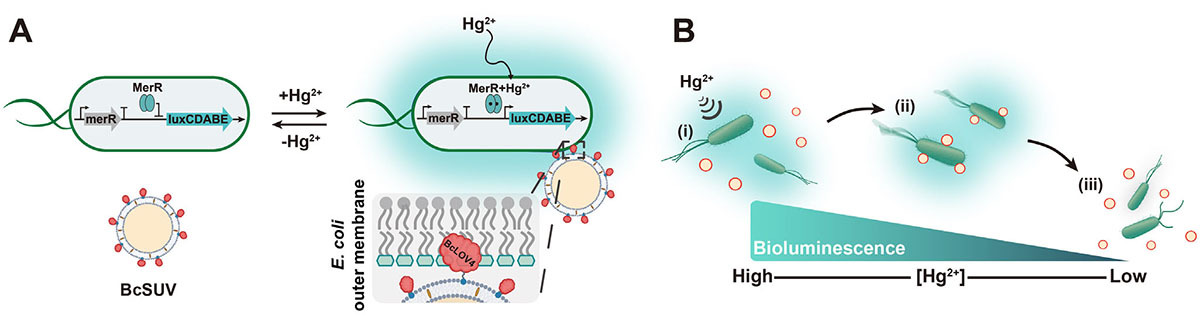 |
| Design of bacterial biohybrid microswimmer for autonomous cargo delivery. (A) Schematic illustration of the dynamic assembly and disassembly of the bacterial biohybrid, regulated by light-mediated communication between engineered E. coli merR-lux bacteria and the cargo; SUVs functionalized with the blue light-responsive protein BcLOV4 (BcSUVs). In the presence of Hg2+, the merR-lux bacteria produce a bioluminescent signal, which is detected by BcSUVs. Consequently, BcSUVs bind to the bacteria, leading to the assembly of bacterial biohybrids. Conversely, in the absence of Hg2+, the bacteria stop luminescence production, causing the unbinding of the BcSUV cargo. (B) An overview of autonomous cargo transport in the Hg2+ gradient. (i) Under high Hg2+ conditions, merR-lux bacteria signal the presence of the toxin to BcSUVs via a bioluminescence light signal, triggering the formation of biohybrid microswimmers. (ii) Bacteria transport the cargo toward lower Hg2+ concentrations due to innate negative chemotaxis to Hg2+. (iii) Under low Hg2+ conditions, bacteria stop producing bioluminescence, resulting in cargo release. (Image: Reproduced from DOI:10.1002/adma.72950, CC BY) (click on image to enlarge) |
| The design has two modular parts. The bacteria carry a genetic circuit called merR-lux: when mercury(II) ions are present, the MerR protein switches on a set of luciferase genes, and the cell emits blue bioluminescence. The intensity scales with mercury concentration. Remove the mercury, and the glow fades within about an hour as the luciferase enzymes degrade. |
| The cargo consists of small lipid vesicles, roughly 160 nm across, coated with a light-sensitive protein called BcLOV4 from the fungus Botrytis cinerea. When struck by blue light, BcLOV4 exposes a positively charged region that binds to negatively charged membranes. The bacterial bioluminescence peaks at 482 nm, landing squarely within the protein's activation window of 450 to 480 nm. |
| The team uncovered a previously unknown property of BcLOV4 that made the whole system possible. The protein had been shown to bind to mammalian cell membranes and synthetic vesicles, but no one had tested it on bacteria. It attached to the bacterial outer membrane within 15 seconds of blue light exposure and released within about one minute in the dark. |
| Combining the two components revealed how the communication loop works in practice. In a mercury-rich environment, bacteria glowed, activating BcLOV4 on nearby vesicles. Those vesicles then bound to the luminescent bacteria over roughly five minutes. Only glowing cells attracted cargo; dark neighbors sitting side by side were ignored entirely. |
| Attaching the vesicles did not cripple the bacteria's swimming. Unloaded cells moved at about 17.2 µm per second. With vesicles bound and 1 µM mercury present, speed dipped to 13.7 µm per second, a modest reduction that left the microswimmers fully functional. The question, then, was whether the system could also shift into reverse. |
| After three hours of mercury exposure followed by washing, bacterial bioluminescence dropped sharply. Vesicles that had bound during the bright phase gradually detached as the light faded. This produced a transient assembly cycle governed entirely by environmental mercury levels. Under constant mercury, vesicles remained stably attached. |
| A chemotaxis chamber provided the final proof of concept. One side contained 1 µM mercury; the other was mercury-free. The team loaded preassembled microswimmers into the chamber along with 12 µm polystyrene beads as obstacles. Over two hours, bacteria migrated toward the clean side, driven by innate negative chemotaxis to mercury. |
| As they arrived and their bioluminescence dimmed, vesicle fluorescence on bacterial surfaces fell by 51 percent within one hour. On the mercury-rich side, it dropped only 9 percent. The beads had no measurable effect, suggesting the microswimmers can navigate cluttered environments. Control experiments with uniform mercury on both sides confirmed that cargo release depended on the gradient, not simply on elapsed time. |
| The full sequence amounts to a self-regulatory feedback loop. Mercury triggers bioluminescence, which triggers cargo attachment, which hitches the vesicle to a bacterium already fleeing the toxin through chemotaxis. Once the bacterium reaches cleaner water, its glow fades and the cargo detaches. No laser, magnet, or operator plays a role at any step. Unlike previous biohybrid designs that rely on external supervision, these microswimmers execute a complex task sequence autonomously. |
| The mercury-sensing circuit could be replaced with bioluminescent reporters for hydrogen peroxide, other heavy metals, or organic pollutants. The researchers demonstrated this by showing that a peroxide-responsive reporter also triggered vesicle recruitment. On the cargo side, BcLOV4 could give way to other photoswitchable proteins that control pore formation, protein synthesis, or molecular release. Paired with different bacterial taxis behaviors, such substitutions could yield microswimmers tailored to specific remediation or biomedical delivery tasks. |
| Light offers something chemistry cannot as a communication medium between living and synthetic components. It propagates instantly, needs no diffusion or molecular transporters, and leaves the bacterium's native signaling pathways untouched. For mobile systems where chemical messages would dissipate in the wake, these properties eliminate both lag and crosstalk. The work lays out a modular blueprint, built from established synthetic biology tools, for engineering biohybrid machines whose parts coordinate their own actions. |
 By
Michael
Berger
– Michael is author of four books by the Royal Society of Chemistry:
Nano-Society: Pushing the Boundaries of Technology (2009),
Nanotechnology: The Future is Tiny (2016),
Nanoengineering: The Skills and Tools Making Technology Invisible (2019), and
Waste not! How Nanotechnologies Can Increase Efficiencies Throughout Society (2025)
Copyright ©
Nanowerk LLC
By
Michael
Berger
– Michael is author of four books by the Royal Society of Chemistry:
Nano-Society: Pushing the Boundaries of Technology (2009),
Nanotechnology: The Future is Tiny (2016),
Nanoengineering: The Skills and Tools Making Technology Invisible (2019), and
Waste not! How Nanotechnologies Can Increase Efficiencies Throughout Society (2025)
Copyright ©
Nanowerk LLC
|

|
|
ORCID information
|

Become a Spotlight guest author! Join our large and growing group of guest contributors. Have you just published a scientific paper or have other exciting developments to share with the nanotechnology community? Here is how to publish on nanowerk.com. |


